Drive inland from any beach on Tinos and within a few minutes you will pass one: a two-storey stone tower standing in a terraced ravine, its upper floor pierced with a lacework of slate triangles, diamonds and suns. These are the peristeriones, the famous Tinos dovecotes — close to a thousand of them, more than anywhere else in the Cyclades, and a recent drone survey documented roughly nine hundred of them, valley by valley. They were built for pigeons, but they are really small monuments of Cycladic architecture, raised by the same masons who built the island's stone houses and carved its marble lintels.
Nowhere do they stand thicker than in Tarambados, a green valley about twenty minutes' drive from our own villages, where a signposted path winds past dozens of towers. If you see one thing on Tinos beyond the villages themselves, make it this.
A privilege of the Venetians
Tinos spent five centuries under Venice — seized by the Ghisi family in the wake of the Fourth Crusade, passed to the Republic in 1390, and held until 1715, when it became the last Venetian possession in the Aegean to fall to the Ottomans. It was the Venetians who introduced organised pigeon-keeping, and under their rule a dovecote was largely a privilege of the ruling families. When they left, the islanders kept the birds and claimed the towers for themselves: most of the dovecotes standing today were raised by Tinian farming families in the 18th and 19th centuries, each generation a little bolder with the decoration than the last.
How a dovecote works
The design is beautifully practical. A peristerionas has two floors: the lower one stored tools, the harvest and the precious droppings, while the upper floor belonged to the birds, its walls lined inside with nesting niches of schist. The siting follows rules every farmer knew by heart — on a slope sheltered from the meltemi, the dry north wind of the Aegean summer, close to running water and sown fields, with the openings turned away from the weather so the flock can land calmly. That is why you rarely see a dovecote on a ridgeline, and almost always find them in quiet files along a valley floor, as at Tarambados.
Reading the stone embroidery
The celebrated facades are not mere ornament. Thin plates of local schist are set into the masonry in geometric patterns — rhombuses, triangles, suns, cypress trees — and every projecting edge doubles as a perch, every opening is sized exactly for a pigeon and too tight for a hawk. The latticework ventilates the loft and breaks the wind. But there was pride in it too: families competed over whose tower wore the finest stone embroidery, and no two dovecotes on the island are alike. It is folk architecture at its most refined — the same Cycladic instinct for geometry that shapes the whitewashed lanes and marble fanlights of the villages, turned to the service of a bird.
Why a thousand towers?
Because pigeons earned their keep three times over. The squabs were a delicacy, braised or baked in the wood oven, and a valued export to the markets of Constantinople and Smyrna. The droppings — the koutsoulia — were the best fertiliser the island had, spread on vines and vegetable terraces each winter. And a fine dovecote carried social weight: it appeared in dowry agreements alongside fields and stone houses. The economics faded in the twentieth century, but the towers are lovingly restored today — since this year they even have a digital atlas of their own, one of the stories in our guide to the Tinos cultural events of summer 2026.
Walking the Tarambados valley
The classic dovecote walk starts at Tarambados, just off the road that runs north from Chora towards Kampos. A signposted path drops from the hamlet into the terraced valley below, where dozens of towers — the densest cluster on the island, several of them handsomely restored — stand among reeds, fig trees and old threshing floors. Give it an unhurried hour. Morning light is kindest, raking across the schist so the patterns stand out in shadow; most dovecotes are private and a few still keep birds, so enjoy them from the path. If the walk leaves you wanting more, Tinos has some 150 kilometres of waymarked trails — we wrote a full guide to hiking on Tinos.
Where to stay for the dovecote valleys
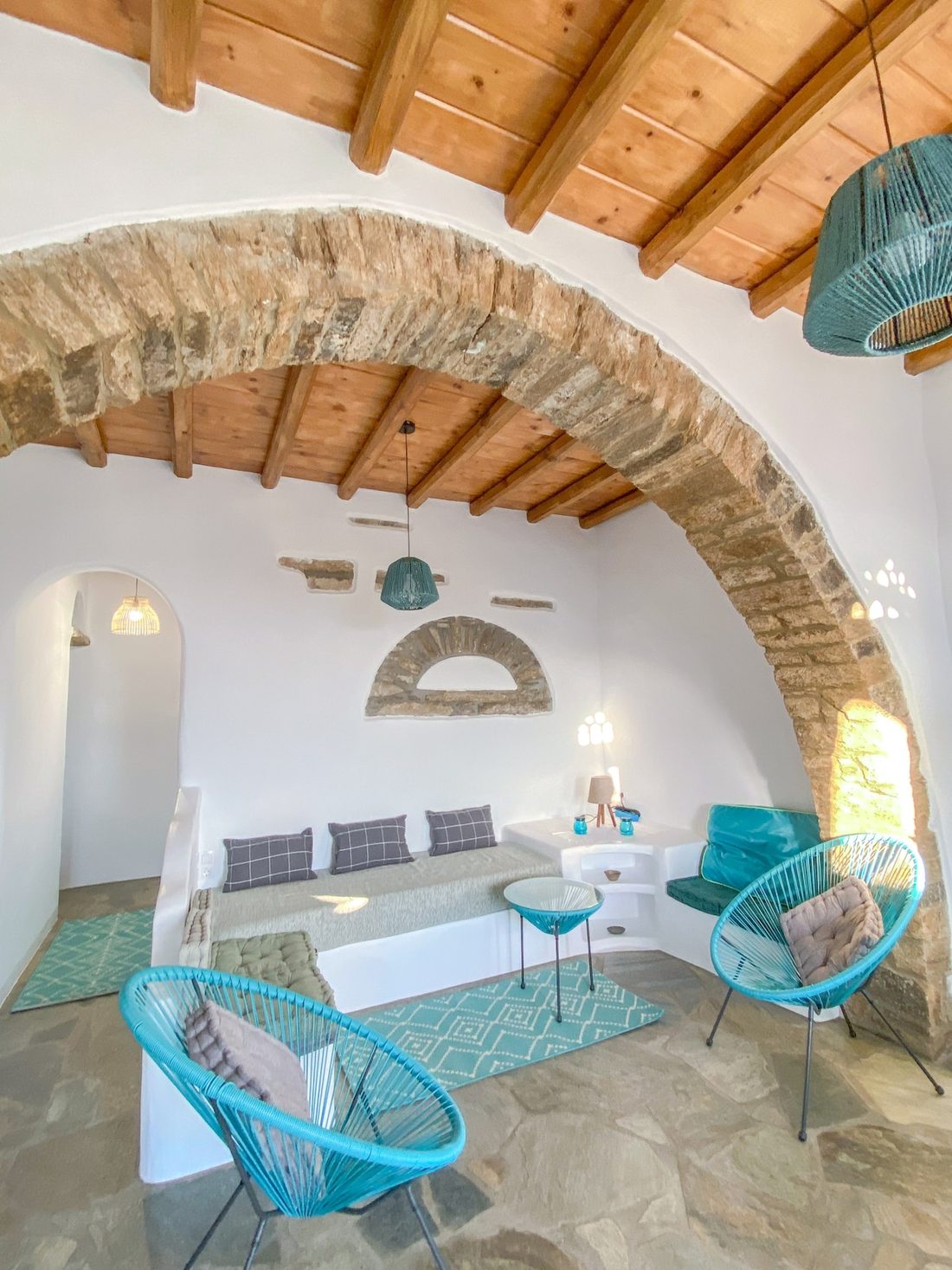
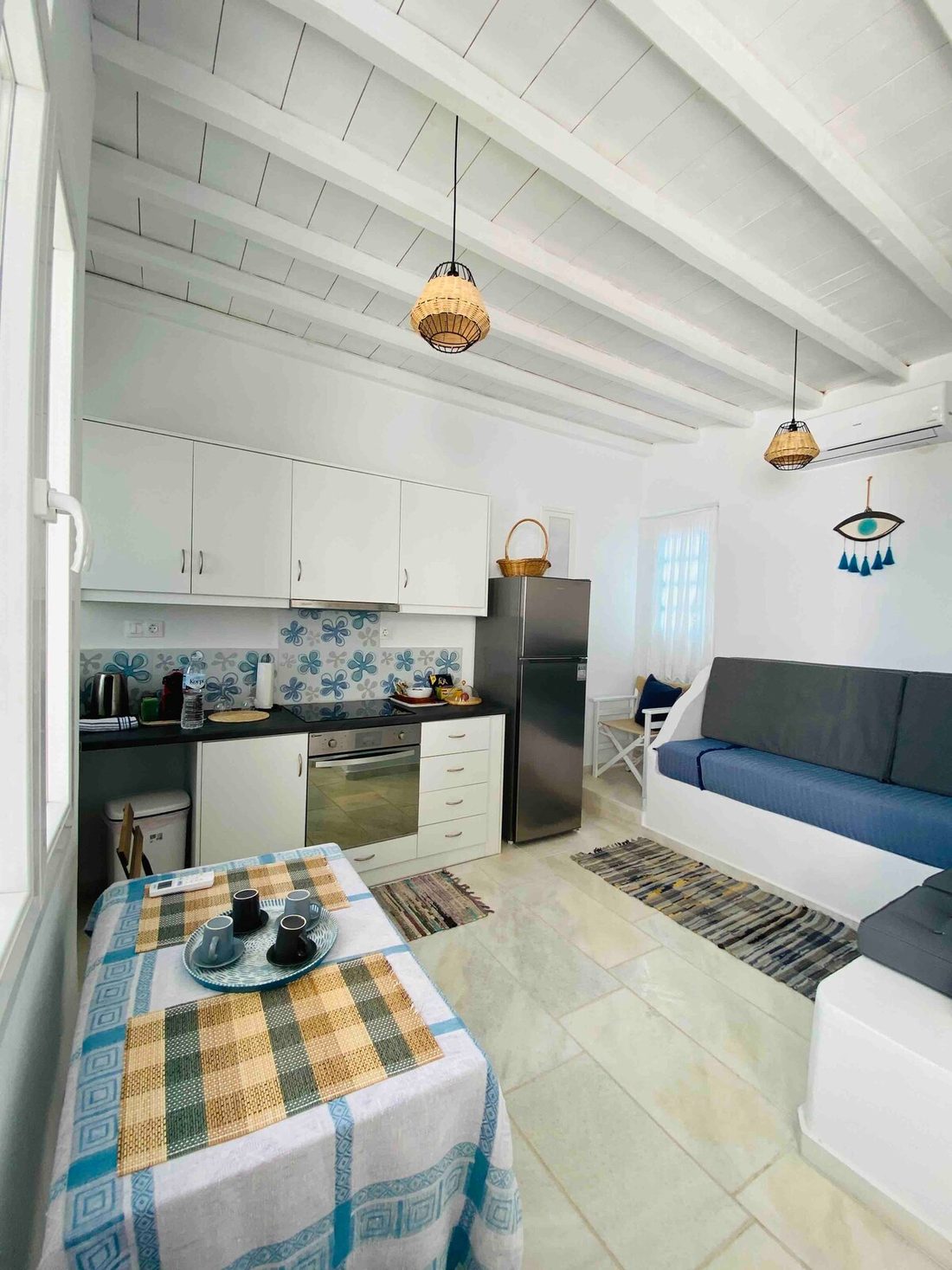
Our four holiday houses sit in Dyo Choria and Triantaros, two balcony villages high above the Aegean — freshly renovated stone houses with marble lintels and whitewashed vaults, true Cycladic architecture turned into comfortable vacation rentals with sea-view terraces. Dovecotes dot the ravines below both villages, and Tarambados is an easy drive across the island, which makes the houses a natural base for exploring the quiet, rural side of Tinos. Read our guide on where to stay in Tinos, then message us through the contact section — we are happy to mark the best dovecote valleys on your map before you arrive.