Most islands have one famous town and a scatter of resorts. Tinos has villages — somewhere between forty and fifty of them, sewn across the mountains in marble and whitewash, each with a square, a spring and a patron saint. They are the real reason to come. If you are mapping out the Tinos villages worth your time, start with these, and leave room to get pleasantly lost.
Arnados and the high country
Park below and walk up. Arnados sits high on the slopes of Mount Kechrovouni at around 450 metres, one of the oldest settlements on the island, lived in since the 13th or 14th century. Its signature is the stegadia — covered passages where the houses arch right over the lane, so you pass from bright sun into cool whitewashed tunnels and out again. There is a small but lovely Ecclesiastical Museum beside the Church of the Ascension, and the view falls away to the Aegean on both sides. Neighbouring Dyo Choria and Triantaros, where our houses are, share this same balcony of mountain a few minutes along the ridge.
Kardiani, cascading to the sea
On the green western flank of the island, Kardiani spills down a steep ravine on the slopes of Mount Pateles, around 260 metres up, with one of the most spectacular sea views in the Cyclades. It is often called the most beautiful village on Tinos, and on a first visit it is hard to argue. Spring water runs everywhere — a creek through the village, marble fountains at the corners — keeping the gardens green into summer. Two churches crown it, the Catholic Panagia and the Orthodox Agia Triada, and the ravine drops all the way to Giannaki Bay for a swim afterwards.
Ktikados, a marble balcony above the bay
Just north of Chora, Ktikados perches in a hanging valley with a blue-domed church and an elegant marble bell tower. Its lanes pass under stone archways and beneath windows framed with carved marble fanlights; a marble-paved courtyard at the village edge looks straight out over the bay of Ysternia. It is also one of the island's quiet food stops — the village tavernas are well loved — which makes it an easy first or last stop on a day of village-hopping.
Reading Cycladic architecture
Half the pleasure of the Tinos villages is learning to read them. Look for the marble lintels and fanlights above the doorways, often carved with a sun, a cypress or a ship by the same hands that worked the island's famous quarries. Look for the dovecotes — peristeriones — those tower-like stone houses for pigeons, their faces laid in geometric lacework. And look at the whitewash itself: cubic stone houses packed tight against the wind, lanes deliberately crooked to break the meltemi, bell towers shaped by hand. This is Cycladic architecture in its most complete, least touristed form.
Villages worth the detour
If you have more days, Pyrgos in the north is the marble-carving capital, all white dust and sculptors' workshops; Volax sits in a surreal field of giant granite boulders; Tarambados hides the island's prettiest valley of dovecotes; and Ysternia strings along the western road toward the sunset. None of them are far — Tinos is small, and the joy is the driving in between.
Where to stay among the villages
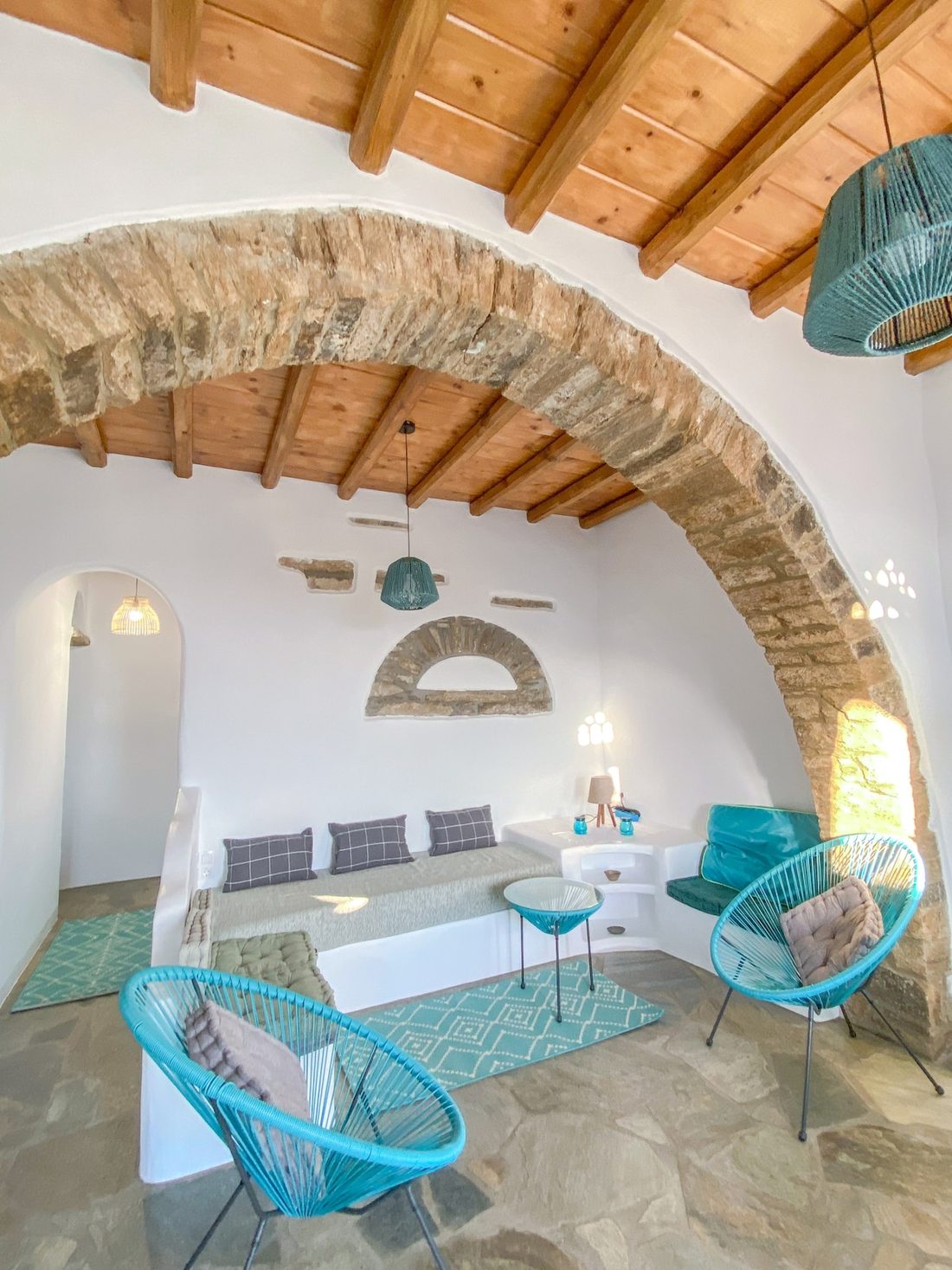
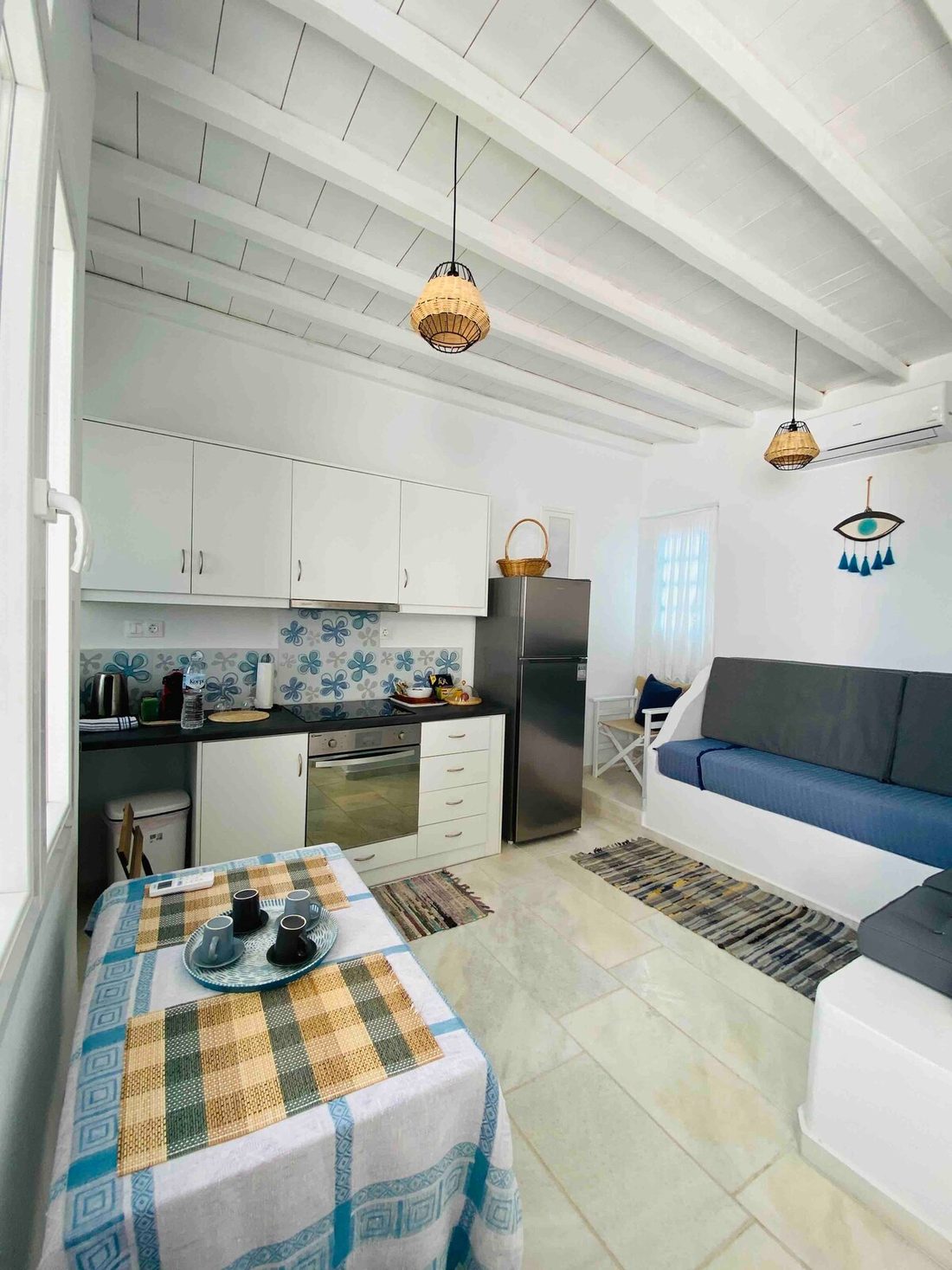
We live at the quiet end of all this. Our four holiday houses sit in Dyo Choria and Triantaros, two neighbouring balcony villages on the southern ridge — freshly renovated traditional Cycladic architecture, stone walls and marble thresholds turned into comfortable vacation rentals with terraces over the Aegean. They make an ideal base for exploring the Tinos villages: central enough to reach Kardiani or Pyrgos in half an hour, quiet enough to feel like your own. If you are deciding where to stay in Tinos, see the houses below and message us through the contact section for dates and our best direct rate.