Drive across Tinos on almost any summer night and you will find one before you see it: strings of light over a church square, a violin tuning up, the smell of grilled meat drifting past a stone bell tower. This is a panigiri — the village feast that is, more than the marble quarries or the meltemi wind, the true pulse of a Tinian summer. More than twenty of them fill the calendar between late June and early September, each tied to a saint, a chapel, or a memory older than anyone now living. Here is where they come from, how one actually unfolds, the dates worth planning around, and how to be a good guest when you find yourself, quite by accident, dancing in a stranger's village square.
What Is a Panigiri? Roots in Faith and a Word for “Everyone Gathers”
The word panigiri comes from the ancient Greek panegyris — pan, "all," and ageirein, "to gather." Long before it meant a church feast, it meant a general assembly, often religious, drawing people from many towns to one sanctuary. Christianity kept the shape and gave it saints: every Orthodox chapel on the island is dedicated to a holy figure or a moment in the church calendar, and on that figure's day, the parish holds its panigiri. Tinos adds its own layer, because Orthodox and Roman Catholic parishes sit side by side here — a legacy of Venetian rule that lasted until 1715, longer than anywhere else in the Cyclades — so in villages like Xinara and Loutra, Catholic feast days share the summer calendar with their Orthodox neighbours, sometimes honouring the very same saint on a different date. Either way, the gathering is the point: family who left for Athens or further abroad plan their visits home around their village's one night of the year.
The Rhythm of the Night: Vespers, Litany and the Long Table
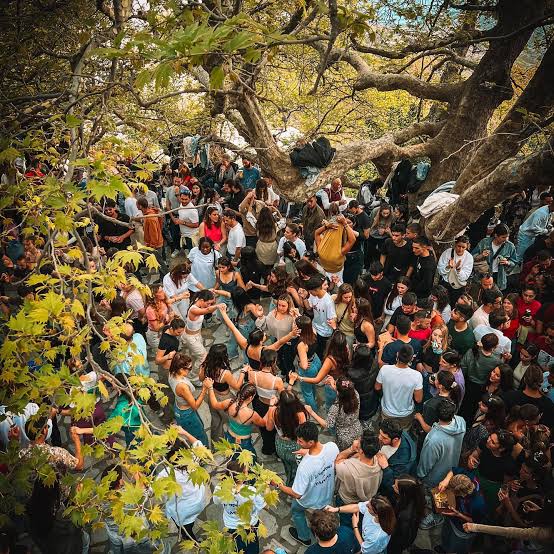
A panigiri has a shape you could set your watch by, even if it runs until sunrise. It begins the evening before the saint's day with the esperinos, the vespers service, followed by a litania — the icon carried in procession around the church and sometimes through the village lanes, incense and chanting drifting between the stone walls. Only then does the square turn into a feast: the local cultural association sets up long tables end to end, chairs appear from nowhere, and a kitchen team that has been cooking since dawn starts sending out trays. A violin and laouto — the Greek long-necked lute — strike up first, occasionally joined by the reedy drone of a tsabouna, the island bagpipe, and the dancing (syrtos, balos) starts slow around the outer rim of the square before it loosens up well after midnight. Nobody checks tickets. Nobody watches the clock.
The Saints' Calendar: Agia Marina, Profitis Ilias and the Great Feast of Chora
July opens with Agia Marina on the 17th, one of the busiest dates on the calendar, kept in chapels across the island with the same pattern of vespers, procession and open-air feast. Profitis Ilias follows on the 20th from hilltop chapels — true to the prophet, these always sit on a summit, so the panigiri happens with the whole island spread out below and the dancing lit by stars rather than street lamps. Three days later, on the 23rd, Agia Pelagia keeps a quieter, more contemplative feast at the Kechrovouni monastery in the hills above Dyo Choria and Triantaros — fitting, since it was a nun at Kechrovouni, later recognised as Agia Pelagia, whose 1823 vision led islanders to excavate an older ruined church and uncover a Byzantine icon buried since an earlier fire. That icon is why, three weeks later, the whole island converges on Chora for the grandest panigiri of all: August 15, the Dormition of the Virgin, which Tinos keeps as the most important Marian pilgrimage in Greece, at the church built around the icon, Panagia Evangelistria. Pilgrims still approach on their knees along the harbour road as a vow. The date carries a second, heavier memory too: in 1940, an Italian submarine torpedoed the Greek cruiser Elli in Tinos harbour during the feast, an attack still marked quietly at the war memorial before the evening's music begins.
Klidonas: Midsummer Fire and Fortune-Telling in Volax
The oldest panigiri on the calendar barely mentions a saint at all. Klidonas falls on June 24, the feast of Agios Ioannis, and its roots reach back past Christianity to midsummer solstice rites: bonfires go up in village squares, and anyone brave enough leaps the flames for good health in the year ahead, while unmarried islanders once told their fortunes with a jar of "silent water" drawn without speaking a word. In Volax, the granite-boulder village twenty minutes from our houses, the fires still burn in the small square below the rocks — part folk magic, part street party. It sits oddly and wonderfully alongside the more solemn feasts of August, proof that a panigiri does not always need a church to start it. Sometimes a fire and a good excuse will do.
Home Ground: The Oregano Festival of Dyo Choria
The panigiri closest to our own front door is also, by most counts, the biggest on the island. The Oregano Festival — Giorti Riganis — takes over the square of Dyo Choria every July 25th, under the plane trees a short walk from our holiday houses. Thousands come, drawn as much by the crowd as by the food; the air genuinely smells of oregano, the wine keeps coming, and the dancing does not stop until well after sunrise. Ask anyone in the village why it matters and the answer is usually some version of the same thing: it is the one night when Athens empties back into Tinos, when sons and daughters who left for the city or further abroad fly home just for this. Neighbouring Triantaros keeps its own smaller feast day on the ridge above, quieter but no less warmly held, part of the same tradition of stone chapels and long tables that has shaped this whole stretch of Cycladic architecture for centuries.
The Panigiri Table: Patatato, Louza and Wine That Never Stops Pouring
Food at a panigiri is generous rather than fancy, cooked in enormous pots by volunteers who have been at it since morning. The classic dish is patatato, veal or goat slow-braised with potatoes, tomato and a hint of cinnamon, ladled onto paper plates alongside grilled loukaniko sausage. Louza — the air-dried, wine-and-spice-cured pork that is one of the island's signature cold cuts — turns up on every table next to local cheeses like kopanisti and the firmer graviera. Wine is local and inexpensive, some of it from vineyards that grow between the granite boulders near Volax, and raki keeps the tables warm long after the food runs out. For more on the island's food beyond the festival table, see our guide to eating on Tinos. Nobody expects a menu here; you take a seat at whichever table has room, and the food generally finds you before you finish asking for it.
How to Be a Good Guest at a Tinos Panigiri
A panigiri is not a show staged for visitors, and the best guests act like it. Arrive before 9pm if you want a seat or parking near a small village. Bring cash — the local association running the kitchen and bar rarely takes cards, and prices are kept modest on purpose, closer to covering costs than turning a profit. Wear shoes you can dance in, because you will be asked, and nobody minds if you do not know the steps to the syrtos; you learn by the second circle. The night does not really start until after midnight, so pace yourself, and remember it is someone's village and someone's saint, not a nightclub — keep the reverence for the vespers and save the abandon for the dance floor. For the full 2026 Tinos panigiria programme, with exact dates for every village, panigiriatinou.gr keeps the most complete and current schedule we know of, updated through the season.
Where to Stay for Panigiri Season
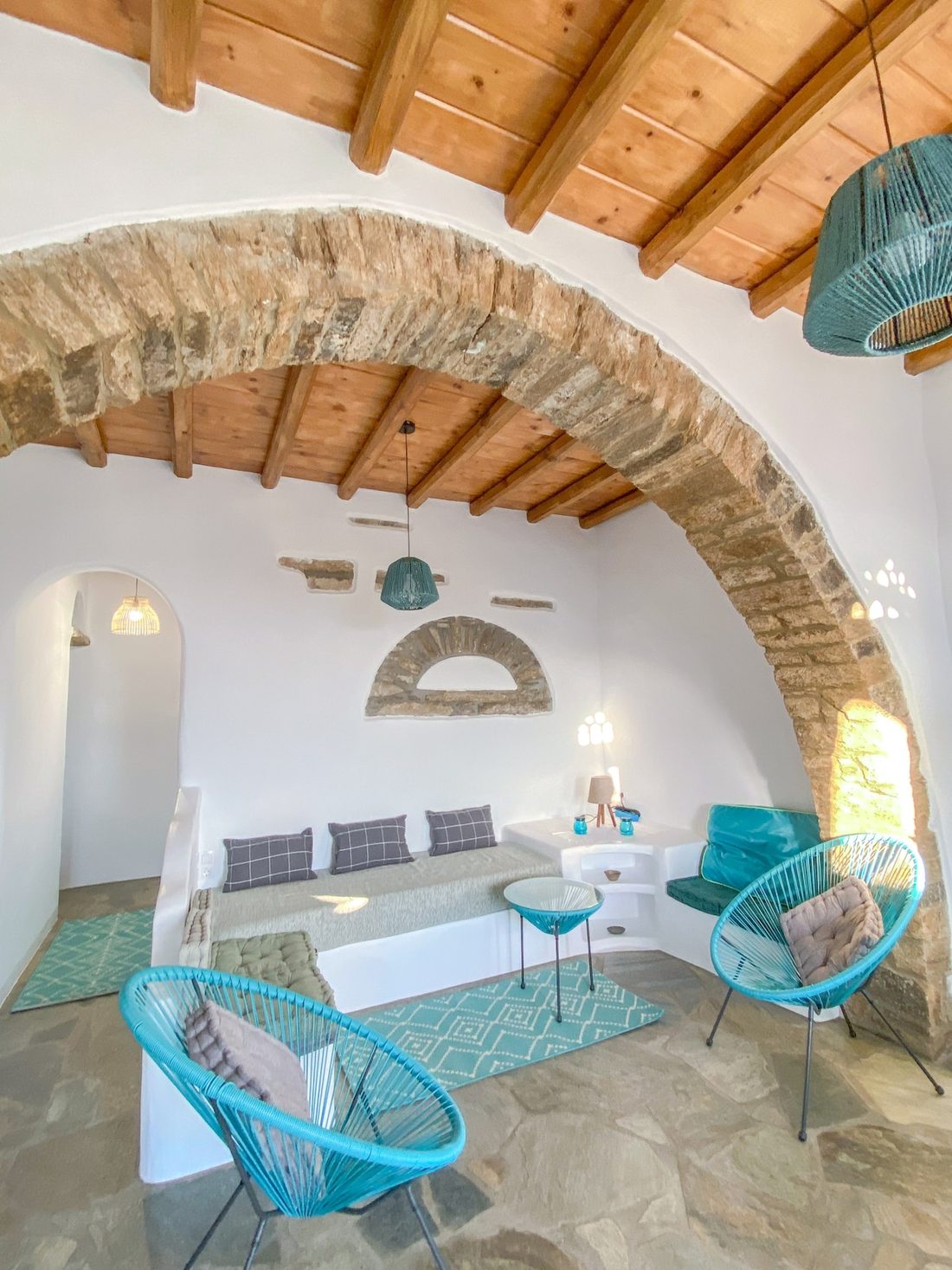
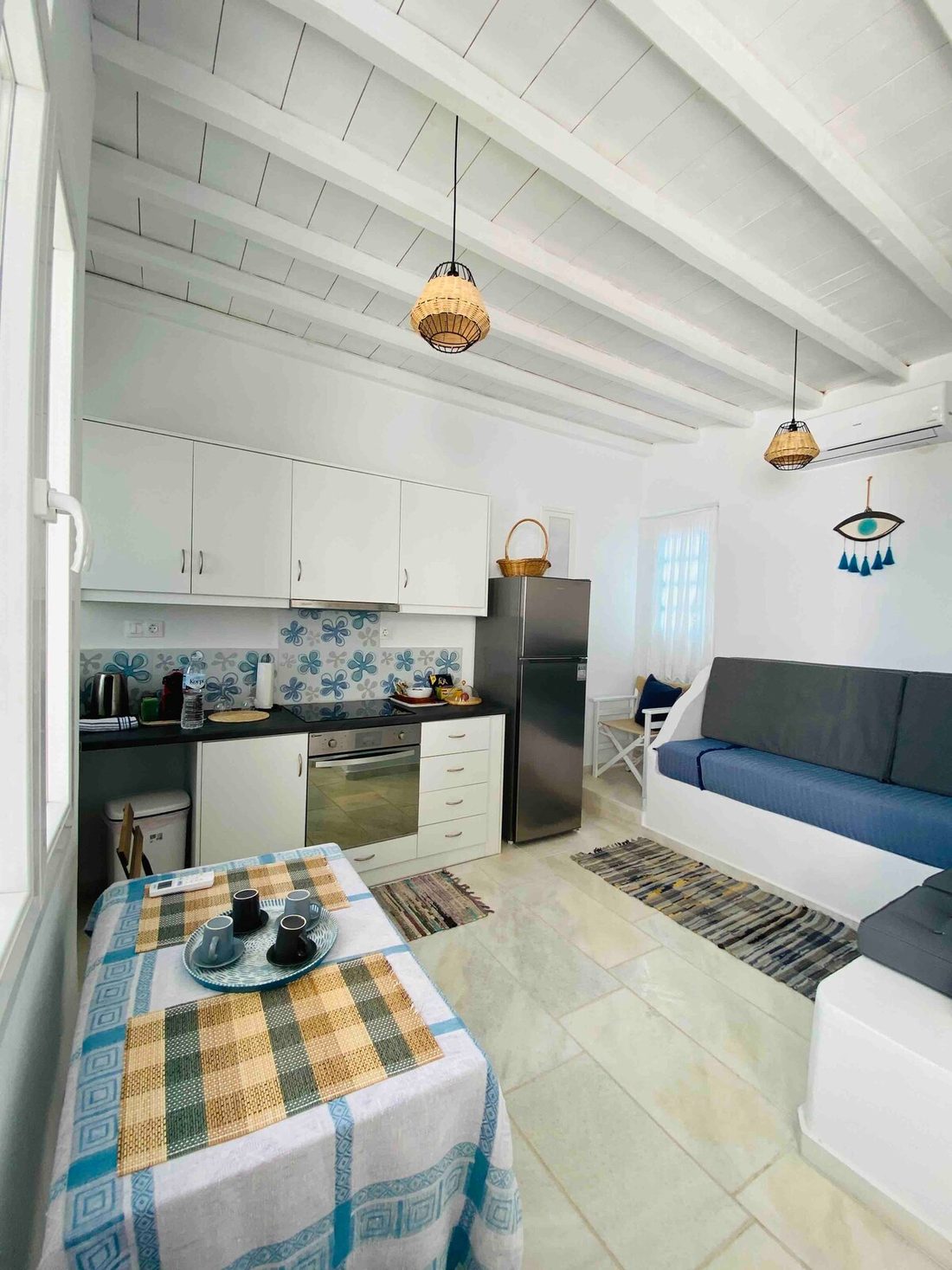
Panigiri season, roughly late June through early September, is also our busiest and most beautiful stretch of the year, and staying close to the villages makes all the difference — you want to be ten minutes from the music, not stranded on the far side of the island at 2am. Our four holiday houses sit in Dyo Choria and Triantaros, two balcony villages on the southern ridge of Tinos, each one a freshly renovated stone house with marble thresholds and a terrace over the Aegean — proper Cycladic architecture turned into a comfortable vacation rental, not a generic build. Some evenings you can hear the violin and laouto drifting up from whichever village is celebrating that night. If you are working out where to stay in Tinos for this year's festival calendar, see the houses below and message us through the contact section for dates and our best direct rate.