On an island famous for marble, the strangest sight is granite. Drive twenty minutes north-east from our villages, up onto the inland plateau, and the terraced hillsides begin to fill with enormous rounded boulders — hundreds of them, some ten metres tall, balanced on the ridgelines like marbles dropped by giants. In the middle of this moonscape sits Volax, the most surreal village on Tinos: a knot of whitewashed stone houses wedged between the rocks, home to a few dozen people, the island’s last traditional basket weavers, and a tiny stone amphitheatre that fills with music on summer nights.
A landscape geologists still argue about
The boulders of Volax are granite in a sea of schist and marble, and that is exactly the puzzle. The accepted explanation is patient chemistry: molten rock that crystallised deep underground 15 to 25 million years ago, was slowly uncovered, and then rounded in place by wind, moisture and temperature — a textbook case of spheroidal weathering, spread across one of the largest boulder fields in Europe. The older explanations are better stories: islanders spoke of the battlefield where the gods fought the Titans, the stones left where they fell, or of a rain of meteorites. Walk out between them in the late afternoon, when the light goes honey-coloured and the granite glows, and you may find the myths easier to believe.
The village between the rocks
Volax itself is tiny — a largely Catholic village of narrow lanes, as much of inland Tinos is, with far fewer residents than boulders. What makes it unforgettable is how the houses negotiate with the landscape. This is Cycladic architecture at its most improvised: cubic stone houses whitewashed to the ankles of a ten-metre monolith, marble lintels over low doorways, courtyards where a granite boulder simply is the fourth wall. Wander slowly: past the church, the old cistern, a small folklore collection in a village house, and lanes that end abruptly in stone the size of a chapel.
Basket weavers and painted poems
For generations the people of Volax wove baskets — sturdy kofinia and delicate bread baskets — from reeds and wicker cut in the damp streambeds nearby, and sold them across the Cyclades. A handful of workshops still work with the doors open; stop, watch, and carry home something genuinely made in the village. Then look up as you walk: the shutters, doors and walls of old houses are painted with verses by Elytis, Seferis, Ritsos and Kavvadias, the work of a retired Athenian who slowly turned Volax into an open-air poetry book. It is a strange and lovely combination — granite, wicker and poetry — and entirely of this island.
A stone theatre in the boulders
At the edge of the village, a small open-air amphitheatre has been fitted into the rocks, and on summer evenings it earns its keep: concerts, theatre and village festivals under a sky full of stars, with the boulders as a stage set no designer could improve. Check the posters in the square when you visit — performances are occasional rather than nightly — and book a table at the taverna afterwards; village evenings here are unhurried in the best way.
Make a day of it
Volax pairs beautifully with its neighbours. Ten minutes away, the valley of Agapi holds some of the island’s finest dovecotes — the peristeriones, their upper storeys laid in geometric stone lacework. The plateau of Falatados next door is where some of the Aegean’s most celebrated vineyards grow between the granite, which we cover in our guide to wine tasting on Tinos. Carry on and the road drops to the wild bay of Livada for a swim. It is an easy loop from our side of the island: about twenty minutes’ drive each way, all of it scenic.
Where to stay for Volax
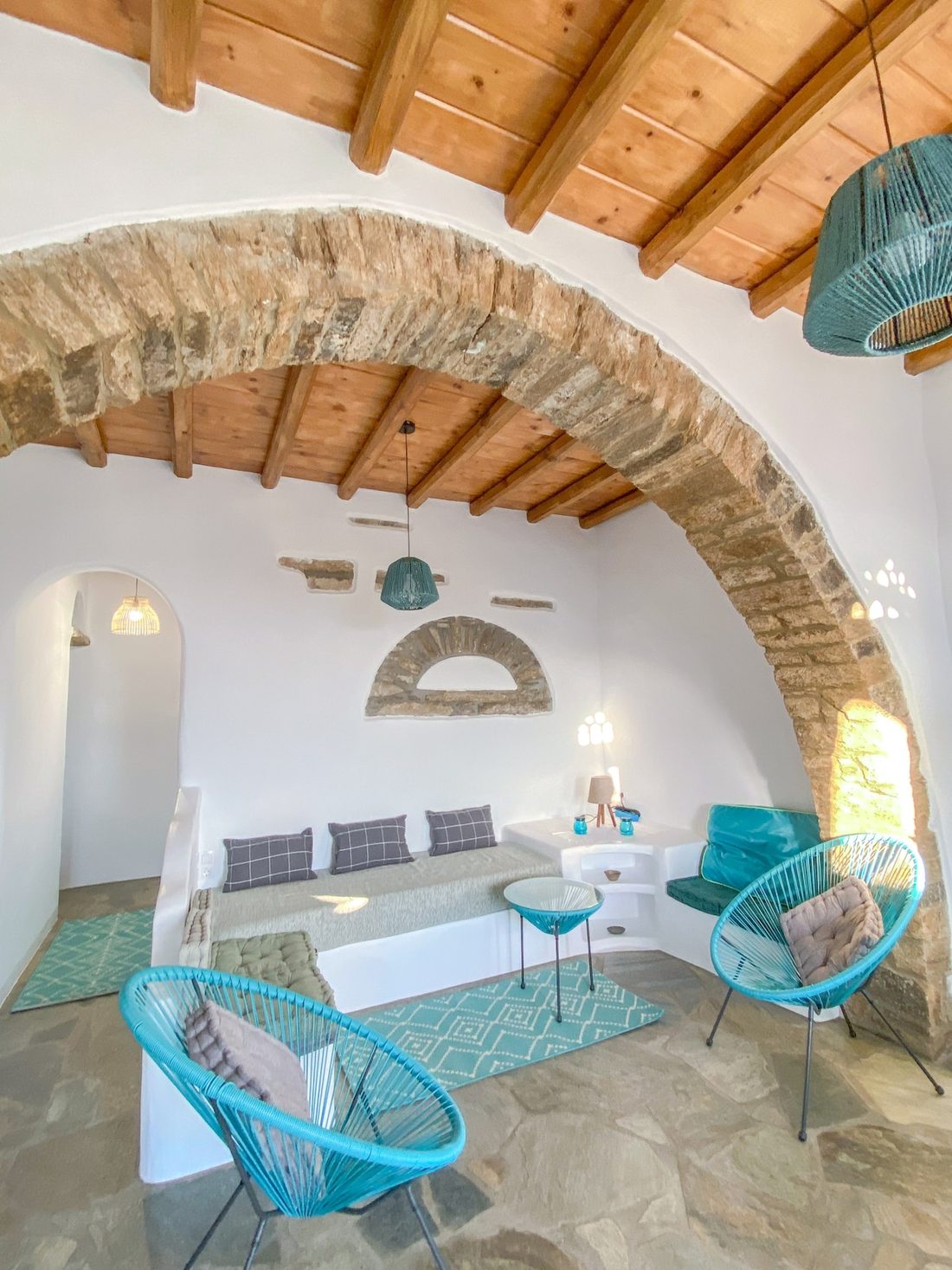
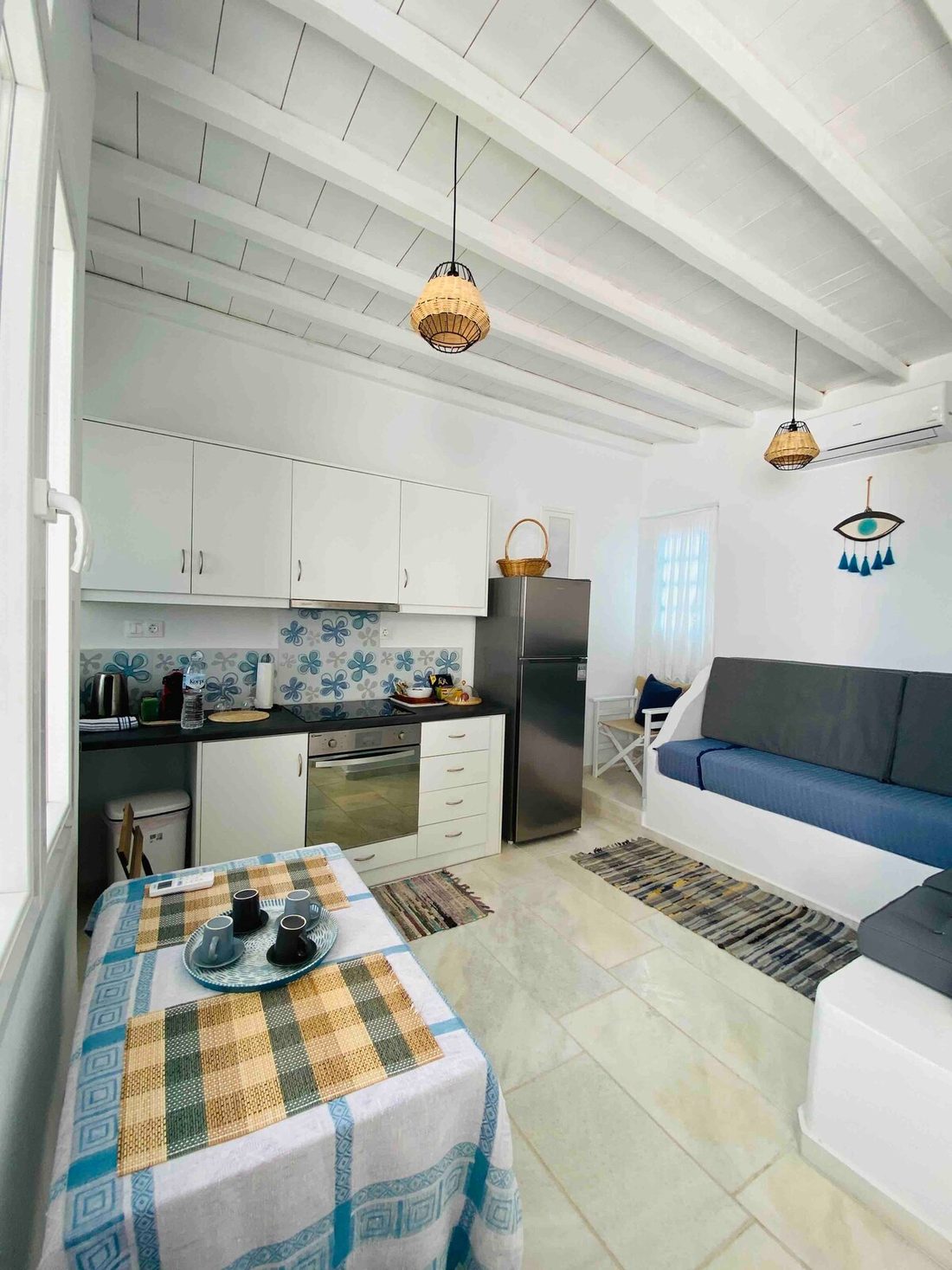
Our four holiday houses sit in Dyo Choria and Triantaros, two balcony villages on the southern ridge of Tinos — freshly renovated stone houses, traditional Cycladic architecture with marble thresholds and terraces over the Aegean, now comfortable vacation rentals. They make an ideal base for the island’s interior: Volax and the boulder plateau in about twenty minutes, the villages, vineyards and dovecote valleys strung along the way. If you are deciding where to stay in Tinos, have a look at the houses below and message us through the contact section for dates and our best direct rate.