Tinos does not hand you a beach. It hands you forty-odd of them, scattered around a coastline that faces every direction at once, and then it sends the meltemi — the dry north wind that defines a Cycladic summer — to make the choice for you. Once you understand that, beach days here become simple, and better than on islands where everyone piles onto the same strip of sand.
Read the wind first, then pick the beach
This is the whole trick, and islanders do it without thinking. When the meltemi blows hard from the north — most reliably from mid-July to late August — go south and east: Agios Fokas, Agios Markos, Kalyvia and Agios Romanos sit in the lee of the mountains and stay glassy while the north coast is white with spray. When the wind swings southerly, flip it and drive north to Kolymbithra and the bays around Panormos. Look at the forecast over breakfast and let the wind pick the beach; it is the one-line briefing we give everyone who stays in our holiday houses.
Kolymbithra, the north-coast classic
Kolymbithra is the most famous beach on Tinos and earns it: a wide bay about fifteen kilometres north of Chora, split by a rocky headland into two beaches the locals call Mikri and Megali Ammos — small sand and big sand. The smaller is sheltered, shallow and organised, with sunbeds and a very good taverna behind the tamarisks. The larger is wilder, and when the meltemi pushes swell into the bay you will find surfers and bodyboards in the shorebreak. Behind both lies a small wetland where herons and migrating birds stop over, an unusual thing to find on a Cycladic beach.
Agios Fokas, Agios Sostis and the sheltered south
The south coast is your insurance policy. Agios Fokas, a short drive from the port, is the island's largest organised beach — long, sandy, shallow, with windbreaks, tavernas and easy parking, which makes it the family default. Agios Sostis has fine pale sand and a picture-book chapel on its point. Kionia, just west of Chora, lies beside the ruins of the sanctuary of Poseidon and Amphitrite and is the easiest swim of all if you have come off the afternoon ferry. From Dyo Choria and Triantaros, these southern bays are fifteen to twenty minutes down the ridge.
Agios Romanos, Ysternia and the sunset side
The west coast is the quiet one. Agios Romanos is a long, calm, tamarisk-shaded bay with shallow water, which makes it one of the best beaches on Tinos for small children and for a late-afternoon swim. Ysternia Bay, below the marble-carving village of the same name, has clear water, a couple of fish tavernas at the shoreline and one of the island's great sunsets; the road down is a run of hairpins with the Aegean opening beneath you. Santa Margarita, further along the same coast, faces due west for the same reason.
The beaches worth a dirt road
If you like swimming without neighbours: Livada, on the wild northeastern coast, is a bay of sand, pebbles and enormous rounded boulders reached down a few kilometres of dirt track, and is usually close to empty. Pachia Ammos, tucked between two hills not far from Chora, has its own sand dune and a proper end-of-the-world feeling. Neither has a taverna, a sunbed or any shade — bring water, wear a hat, and go early or late. A high-clearance car helps, though a normal rental driven slowly is usually fine in summer.
Where to stay for a beach-led week
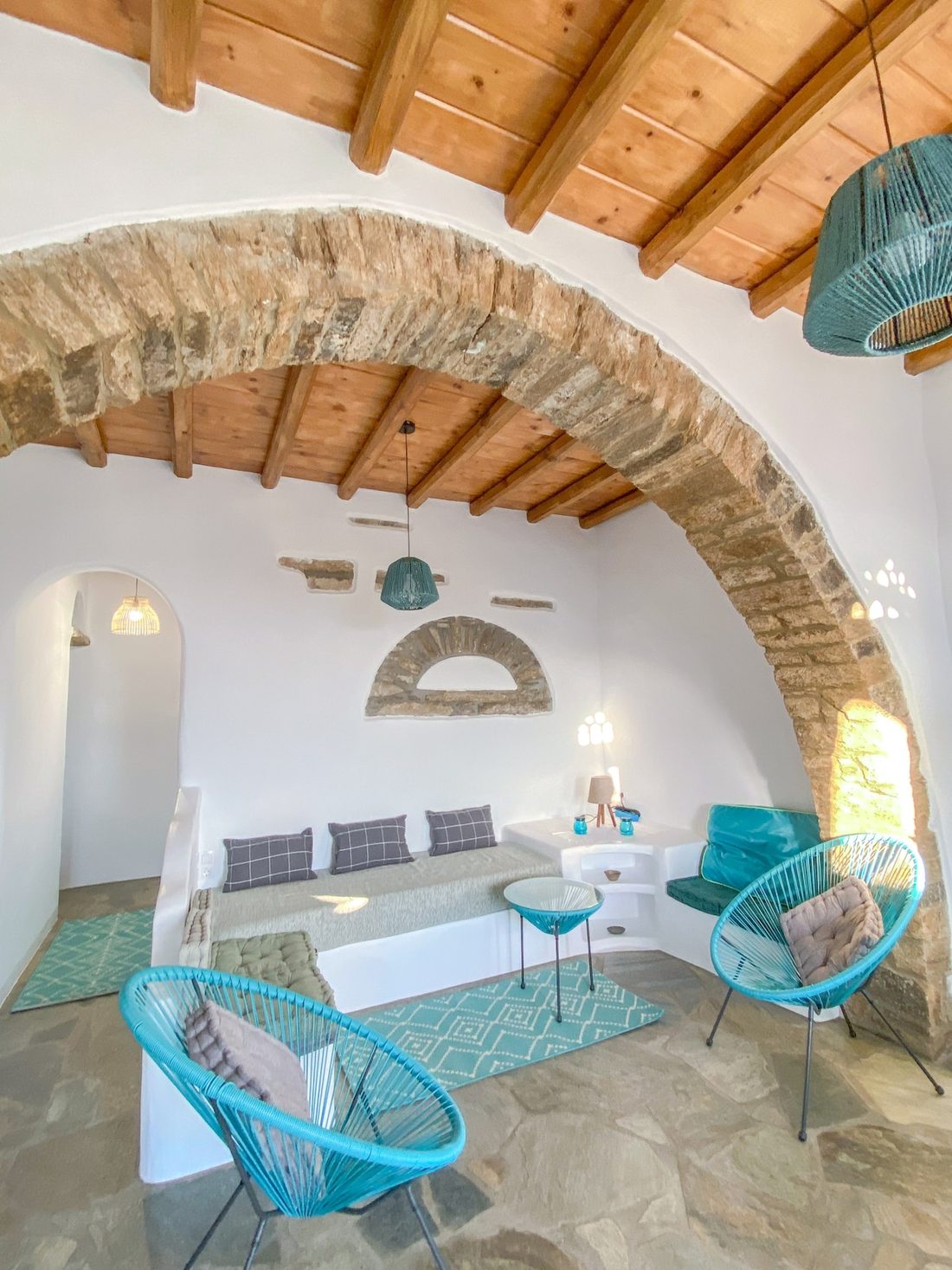
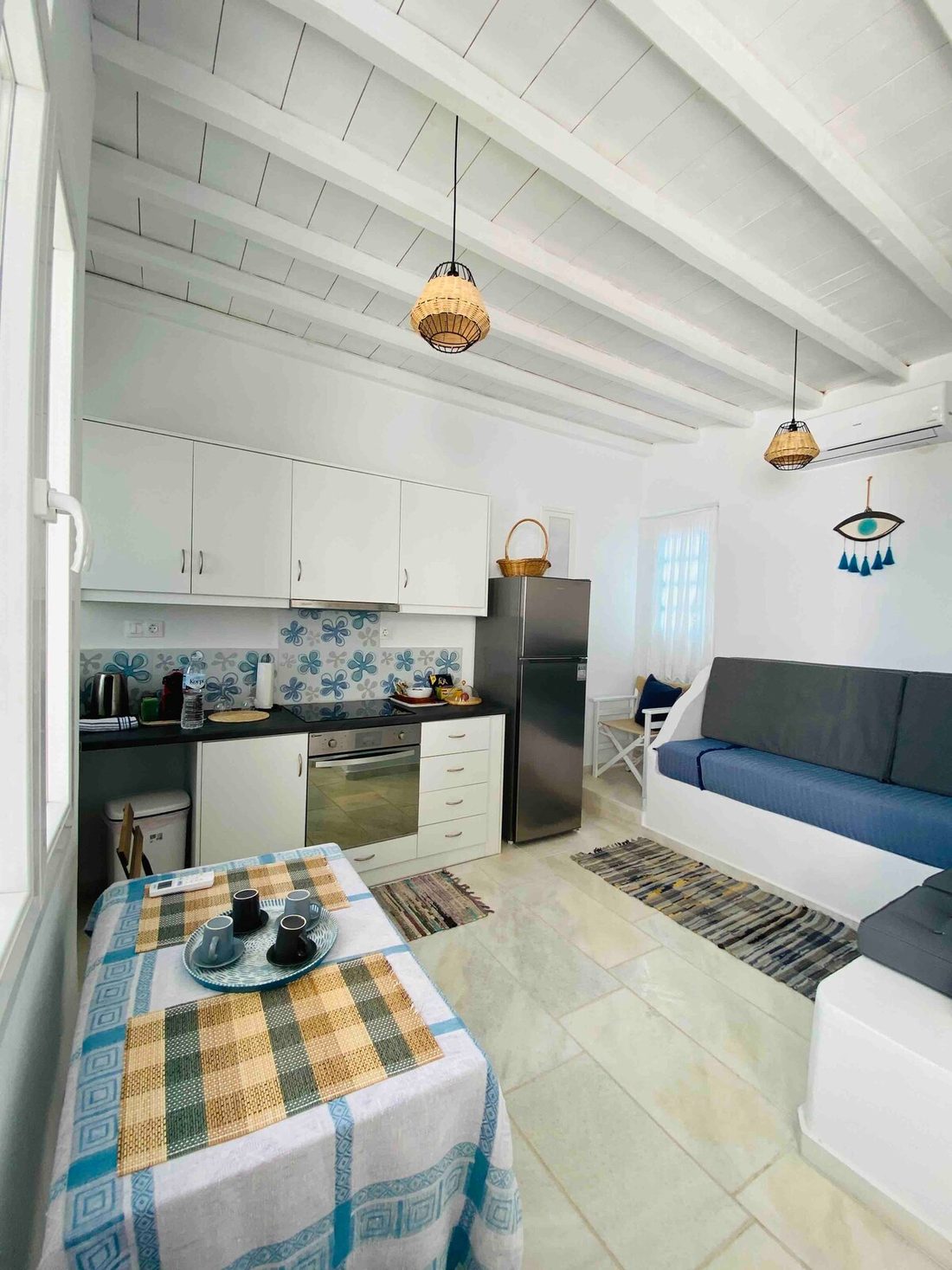
Our four holiday houses sit high on the southern ridge, in the neighbouring balcony villages of Dyo Choria and Triantaros — traditional stone houses with marble thresholds and carved lintels, freshly renovated into comfortable vacation rentals with terraces over the Aegean, a few steps from dovecotes and whitewashed lanes. Being up high is exactly the point: both coasts are within half an hour, so you can check the forecast over coffee and drive to whichever side the wind has left calm. Between swims the villages themselves are worth the detour — see our guide to the villages of Tinos. If you are working out where to stay in Tinos, the houses are below; message us through the contact section for dates and our best direct rate.