Every few weeks someone writes to ask whether they could simply… stay. Work the mornings from the terrace, swim at six, send the invoice on Friday. For Greece the answer is more concrete than it used to be: there is a visa with a number attached, and the rules changed this February. Here is what being a digital nomad in Greece actually involves — and what a working month on Tinos feels like from the inside.
The Greece digital nomad visa, in plain terms
If you carry an EU or EEA passport, none of this applies to you: come and work from here for as long as you like. Everyone else has ninety days as a visitor, and beyond that needs the digital nomad visa.
The shape of it is simple. It is a Type D national visa for people working remotely for employers or clients established outside Greece — you may not work for a Greek company or run a Greek-registered business on it. You show a net income of at least €3,500 a month, rising by 20% for a spouse or partner and 15% for each dependent child. The visa runs for twelve months; once you are here you can apply through the Ministry of Migration and Asylum for a two-year residence permit, renewable.
The part that catches people out is new. Since February 2026 (Law 5275/2026) you must apply at the Greek consulate in your country of residence before you travel. The old shortcut — fly in on a tourist stamp, apply later from a café in Athens — has been closed. The Ministry of Foreign Affairs page is the official starting point, and the Work From Greece guide keeps the document checklist current. Read both before you book anything — ours included.
About that 50% tax break
You will read everywhere that digital nomads get half their income tax waived in Greece. Be careful with that one. The 50% relief under article 5C was written for people who move their tax residence to Greece and take up a new job or self-employed activity here — precisely what the nomad route forbids — so foreign-employer income on a nomad visa is not what it was drafted for. Separately, past 183 days in a calendar year you generally become tax resident, with everything that follows. We are hosts, not accountants: half an hour with a Greek accountant before a long stay is money well spent.
Connection, coffee, and where people actually work
The honest picture. All four of our holiday houses have Wi-Fi, and the Blue Horizon page gives its line as fast Wi-Fi at 29 Mbps — comfortable for calls, screen sharing and ordinary cloud work, less so for pushing raw video all afternoon. Mobile data is the backup everyone ends up using at some point: 4G and 5G reach the villages, and a tethered phone has rescued more than one call.
As far as we know there is still no formal coworking space on Tinos. In practice nobody seems to mind. People work from the house terrace in the morning shade, from a kafeneio table in the village square where the Wi-Fi belongs to the owner, or from a café on the Chora waterfront when they want the noise of other people around them. If a proper desk matters to you, say so when you write, and we will tell you plainly which house suits.
The time zone helps more than people expect. Tinos runs on EET (UTC+2, UTC+3 in summer). A nine o'clock start covers the whole European day, catches colleagues in Asia before they log off, and still leaves your morning clear — the US East Coast only wakes up mid-afternoon here. The swim at six is not a figure of speech; it is the actual schedule.
Come for a month, not a long weekend
Tinos rewards the slower visit. Ferries from Rafina run all year — several a day in summer, dependably through winter; how to get to Tinos has the routes and timings. The months that suit remote work best sit on either side of the crowd: Tinos off-season describes what winter here is really like, and September and October give you a warm sea with the island back to itself. Monthly and low-season stays are priced differently, so it is worth asking.
Where you would actually put the laptop
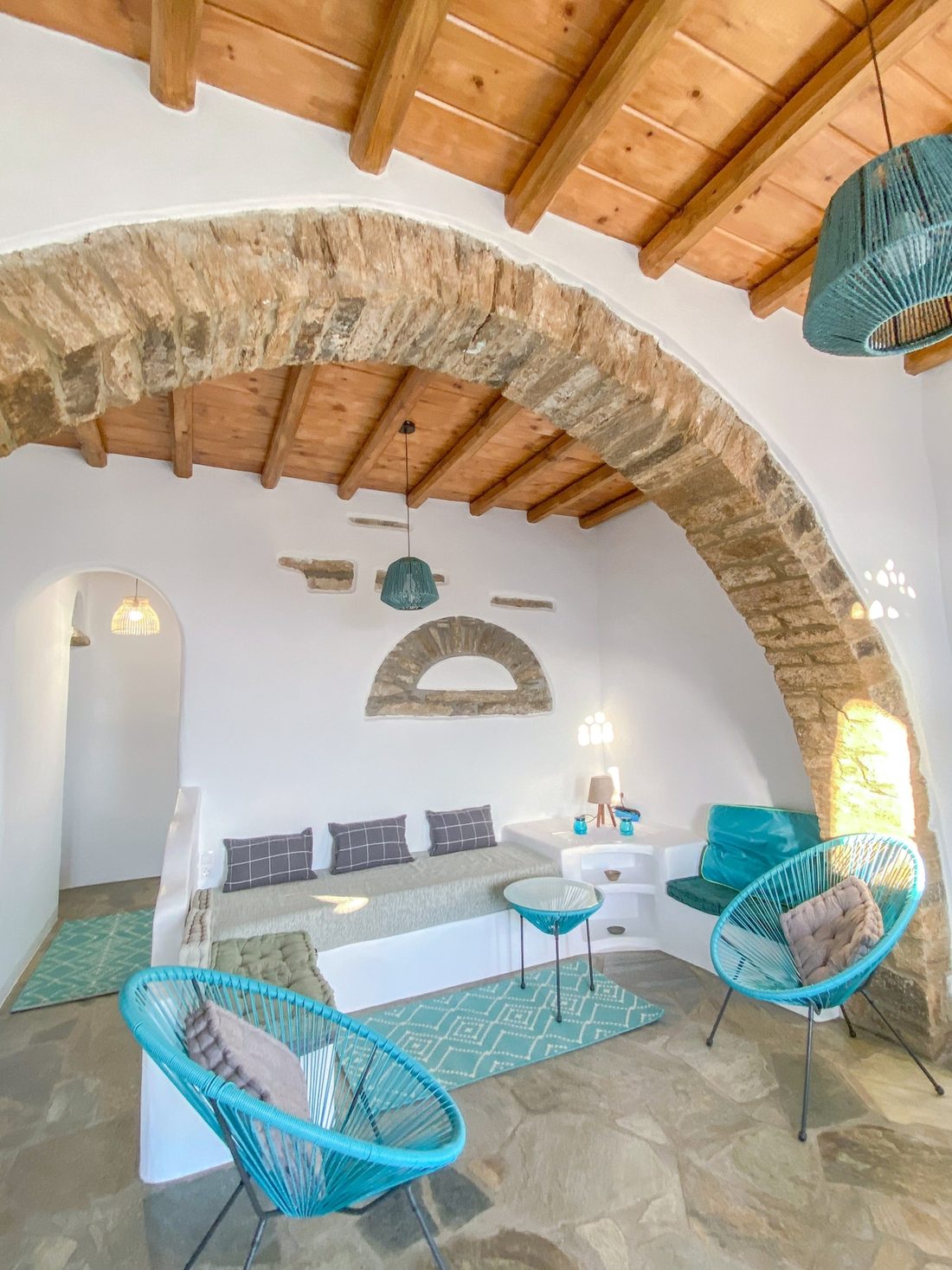
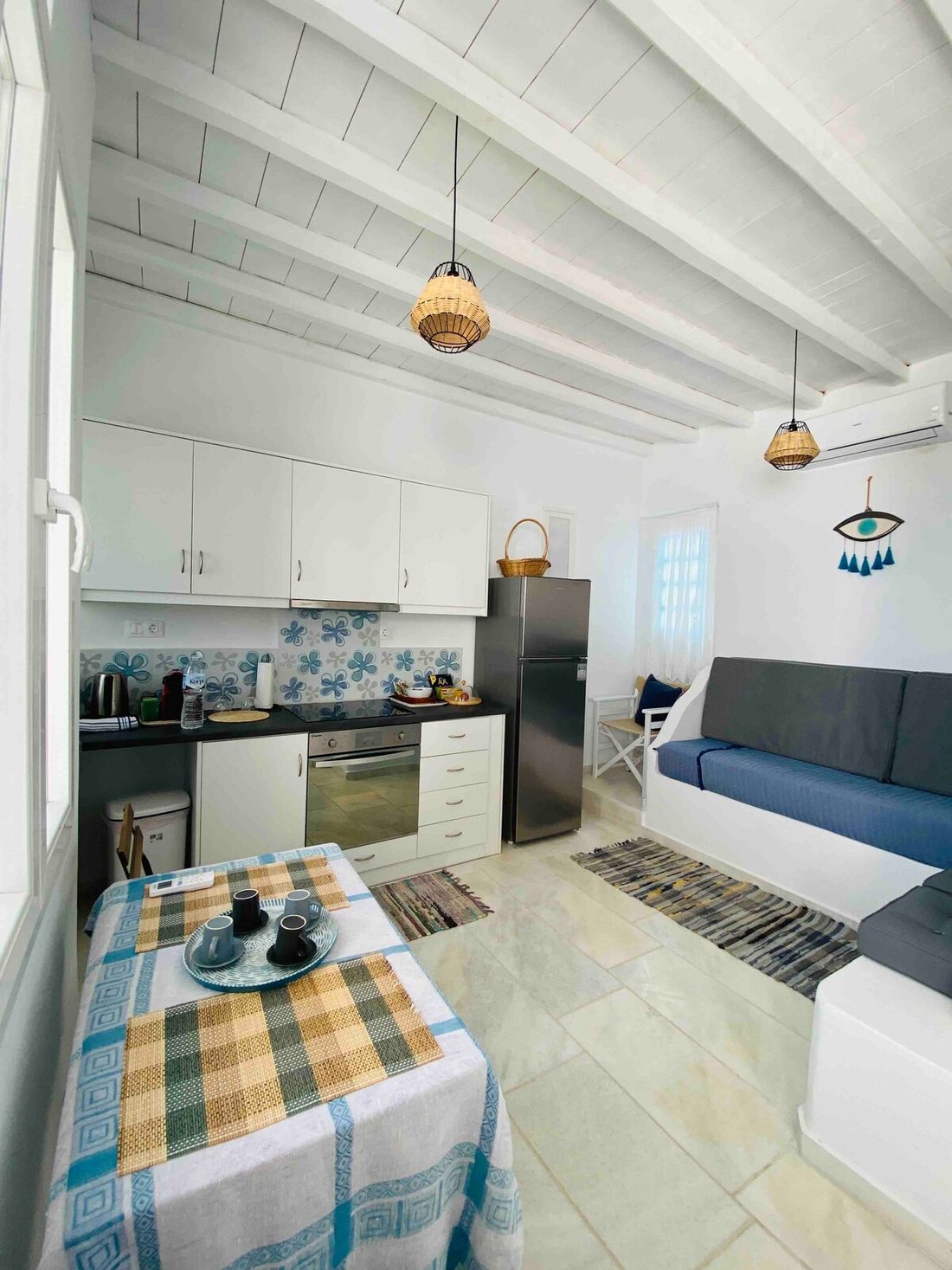
Our four vacation rentals sit in Dyo Choria and Triantaros, two villages on the same southern balcony of mountain, a quarter of an hour above Chora. They are old stone houses — marble lintels above the doors, thick walls that stay cool through August, dovecotes in the valley below — renovated as holiday houses rather than offices, which is rather the point of coming.
For a working stay, two of them get asked for most. Blue Horizon has three bedrooms across two levels, so there is a door you can close and a table that nobody has to clear for dinner. Aegean Selfie House is the one for a couple where only one of you is working: a small house whose terrace becomes an outdoor office by about nine in the morning, and open Aegean after that.
People to ask before you come
Greece has a large and generous remote-work community, and most of your questions have been answered there already. The Facebook groups Greece Digital Nomads and Digital nomads in Greece are the busiest; the Freaking Nomads community directory lists the rest. And if you want a larger island with real coworking within reach, Syros — the administrative capital of the Cyclades — is about thirty minutes away by ferry.
Where to stay in Tinos for a working month
If you are weighing up where to stay in Tinos, the houses are below — Emerald View House One and Blabla Door House alongside the two above. Tell us your dates, how long you are thinking of staying and what your working day needs, and message us through the enquiry form. We would rather answer with what is realistic than with what sells.
Coming between November and March? Our winter on Tinos page has the long-stay offer: 15% off weekly stays of 7 nights or more, with a monthly rate on request.