Ask us when the island is most itself and we will not say August. From November until Easter, Tinos goes back to the eight and a half thousand or so people who live here all year, and the villages above the port run on their own clock again: the kafeneio, the school bus, the church bell, the north wind. It is not a season for everyone — and we would rather tell you exactly what Tinos off-season looks like from a terrace in Dyo Choria than sell you a summer that is not there.
Getting here in winter
Tinos has no airport. The conventional ferries keep running all year: roughly one sailing a day from Rafina, the port closest to Athens airport, and a few a week from Piraeus, with the fast catamarans mostly tied up until spring. The one rule of winter travel is slack: when a gale warning is issued the port authority holds the ferries in harbour, sometimes for a whole day, so never book a flight home for the morning after your last night on the island. Our guide to getting to Tinos has the ports and the road up to the villages.
The weather, and the halcyon days
Winter here is mild by any northern standard and wet by Cycladic ones. January and February bring daytime temperatures of around 13 to 15°C, nights that rarely fall below 8 or 9°C at sea level — a little cooler up in the villages — and roughly a dozen days of rain a month, usually a front that passes in a night and leaves the air rinsed. What defines the season is the wind: the winter northerlies are stronger and colder than the summer meltemi, and they are the reason the old stone houses of the ridge villages were built low, huddled and crooked. Then, somewhere around the middle of January, come the Alkyonides — the halcyon days, a run of still, warm, cloudless days that Greeks have named since antiquity — and you eat lunch outside in your shirtsleeves with Mykonos and Delos sharp on the horizon.
What stays open, and what does not
The beach tavernas close by the end of October and most of the shops along the pilgrims' street in Chora shutter soon after. What remains is the island that works: the harbour cafés and a handful of tavernas in Chora that feed the town year round, the bakeries, the kafeneio in each village. In Triantaros and Dyo Choria you are a two-minute walk from a coffee on most days and from a plate of something hot on many of them — but you will want a car. Panagia Evangelistria is open every day of the year, so is the convent of Kechrovouni above our villages, and the Museum of Marble Crafts in Pyrgos keeps winter hours from mid-October to the end of February, ten to five, closed on Tuesdays. Volax, Pyrgos and the dovecote valleys are yours alone.
The winter feasts
The off-season has its own calendar. On 6 January, Epiphany, the priest throws the cross into the harbour and the young men of Chora dive for it. On 30 January the island keeps its most important day: the anniversary of the finding of the icon of the Evangelistria in 1823, when the icon is carried through the narrow streets of Chora at two in the afternoon, along the same route as the first procession. Carnival follows — Clean Monday in 2027 falls on 15 March, with kites over the beaches — and then 25 March, the Annunciation, which is both the feast of the Evangelistria and Greece's national day. After that the island turns towards Easter, which we wrote about on our Easter in Tinos page: in 2027 it falls on 2 May.
The greenest months
From February the hills that were tawny in August turn an improbable green, the dry-stone terraces fill with anemones and then with poppies, asphodels and wild orchids. It is the best walking weather of the year: the island's restored network of old footpaths — more than 150 km of marble-slabbed mule tracks linking the villages — is empty and cool. Winter also lays the Cycladic architecture bare. With the leaves off the plane trees and the crowds gone, you notice the marble lintels and carved fanlights above the doors, the covered passages that turn the lanes into tunnels against the wind, and the dovecotes standing in the valleys like stone embroidery. Our hiking guide starts several of these walks at our own door.
Winter on the table
Village kitchens follow the season. The louza — the island's cured pork loin — and the winter sausages are made now, after the pig slaughter in December. Kafeneio pots hold wild greens, fennel pies, slow-cooked goat and bean soup; in late autumn the stills run for the year's raki, and by spring the first artichokes of Komi are on the market. Our field guide to eating on Tinos covers the whole year's table.
Where to stay in Tinos off-season
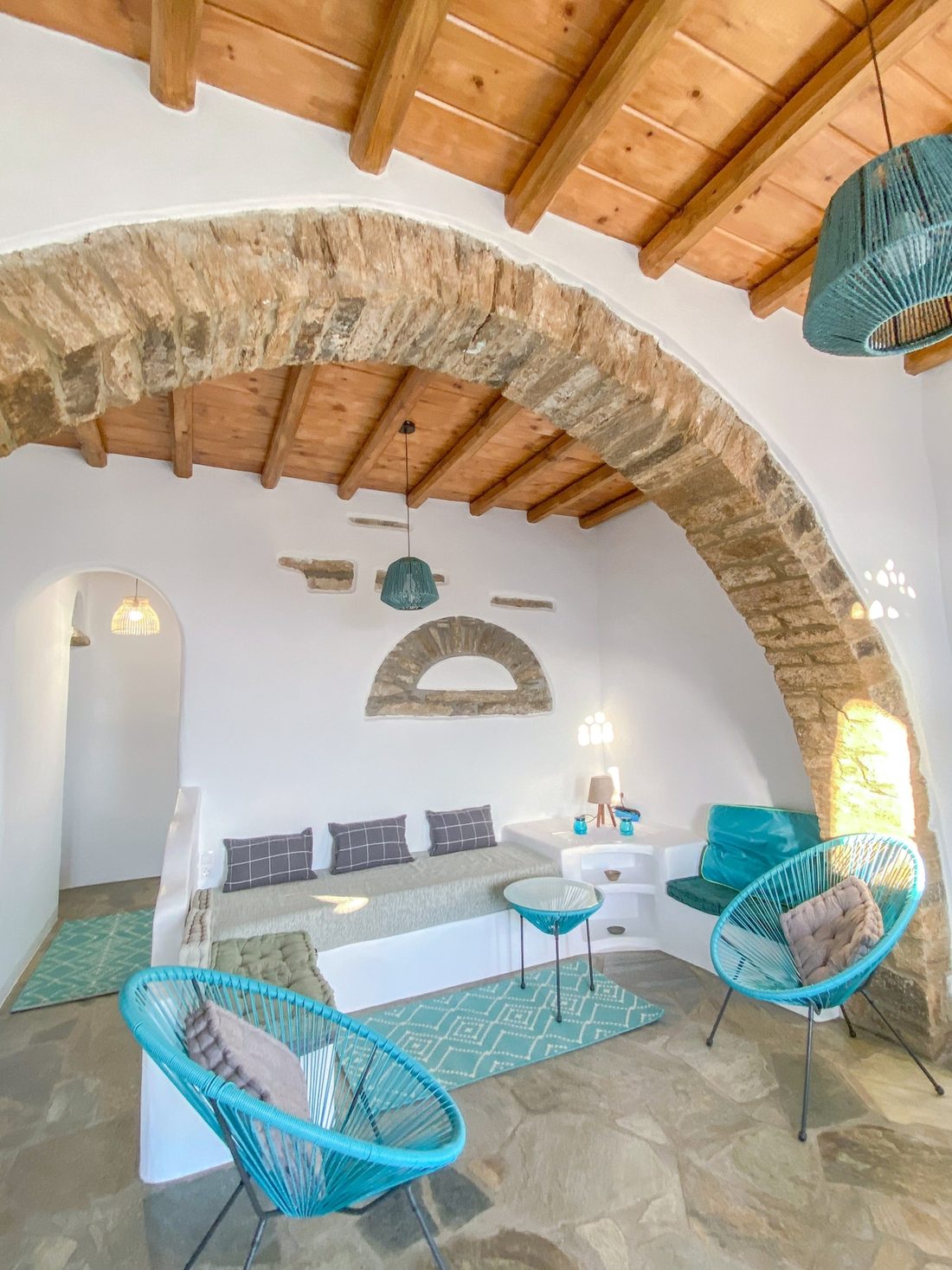
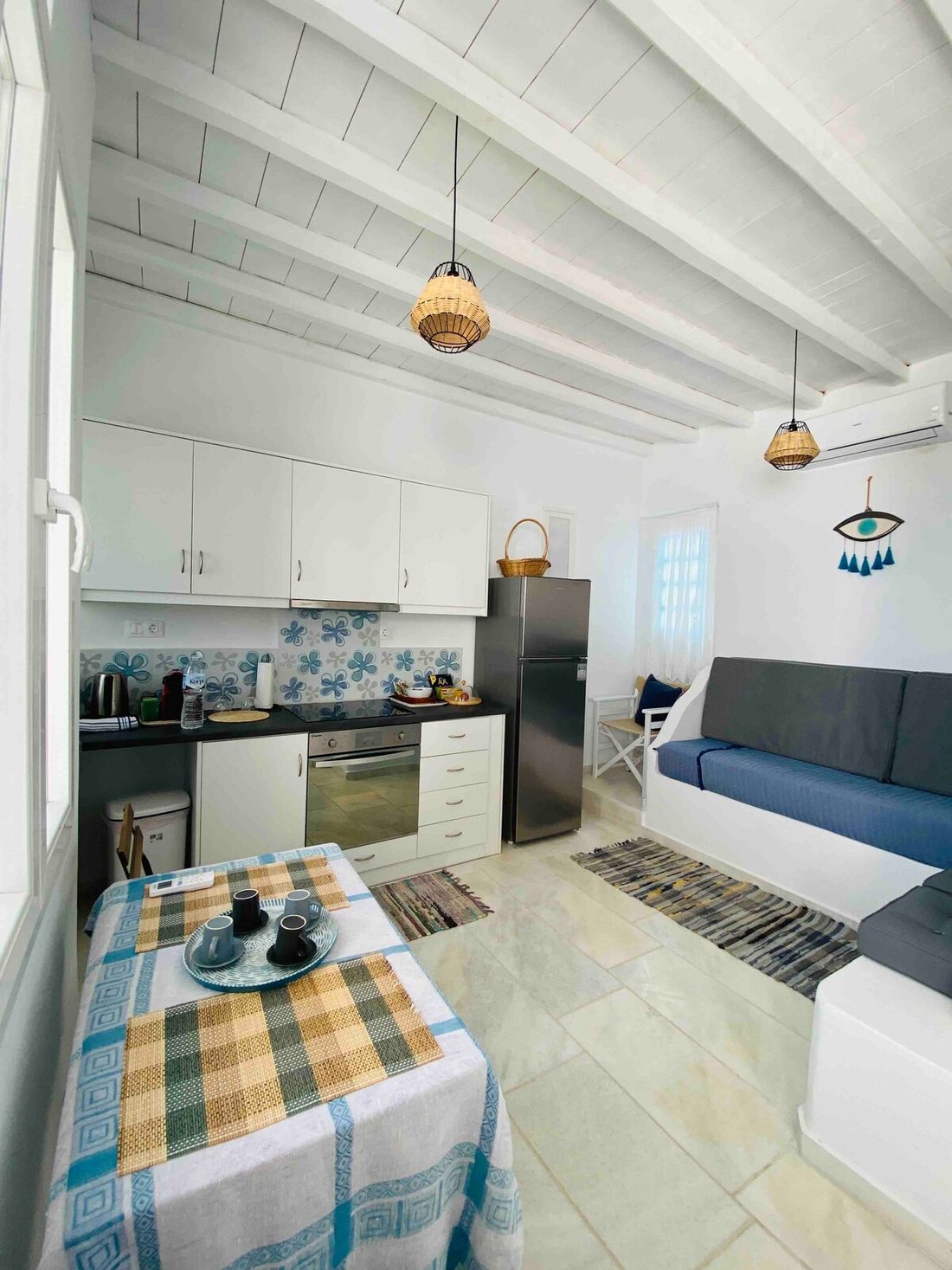
Our four holiday houses sit in Dyo Choria and Triantaros, two neighbouring balcony villages at around 380 metres on the southern slope of Kechrovouni — traditional stone houses with their marble thresholds and timber ceilings intact, renovated into comfortable vacation rentals with terraces that look straight down at the Aegean. Winter suits them: Emerald View House One is steps from the plane-tree square of Dyo Choria, and Blabla Door House sits in the heart of Triantaros with the bell tower for a neighbour. Not every house is open every winter week, so if you are deciding where to stay in Tinos between November and Easter, send us your dates through the enquiry form and we will tell you plainly which house is right for the season and our best direct rate for the quiet months. If your dates are flexible, our September and October page and the month-by-month guide compare the whole year.
For winter 2026-27 the three houses we let for holidays (Blabla Door House is let long-term this year) are heated and open all season; the long weekends, the 30 January feast and our monthly rates are on our winter on Tinos page.