In October 2026 the local news site Tinos Today announced that the organisation Ambassada will hold its fifth dry-stone workshop in Arnados on Saturday 14 and Sunday 15 November. Participants will finish restoring an old path above the village that was recently damaged; the work was requested by residents and friends of the island and commissioned by the Municipality of Tinos (Tinos Today, 28 October 2026). It is free and open to everyone, with registration in advance. It is a good excuse to look properly at something visitors walk past all day: the walls.
What a dry stone wall is, and why Tinos is made of them
A dry stone wall is built without mortar. The builder chooses each stone, turns it until it sits firmly on the ones below, and wedges the gaps with smaller stones, so that the weight of the wall holds it together. The craft is old and shared across the Mediterranean: in 2018 UNESCO added the art of dry stone walling to its list of intangible cultural heritage, a practice carried by several European countries including Greece (UNESCO). On Tinos it is not a museum skill but the reason the hillsides look the way they do.
Terraces, field walls and paths: how to read the landscape
The island is steep and windy, and soil would simply wash or blow away without something to hold it. Generations of farmers stepped the slopes into terraces, each one retained by a low wall, so that grain, vines and vegetable gardens could grow on ground that would otherwise be too steep. Other walls mark the boundaries of fields, shelter small plots from the wind and keep animals in. The paths that link the villages are often walled on one or both sides as well. Once you start noticing them you see them everywhere, curving along the contours like lines on a map.
Around Dyo Choria and Triantaros the walls run through the fields between the houses, and on a walk you pass them every few minutes. They are also part of the picture at Tarambados, where the dovecotes stand among the terraces; our story on the dovecotes of Tarambados shows how the two crafts belong together.
Dry stone and the Cycladic house
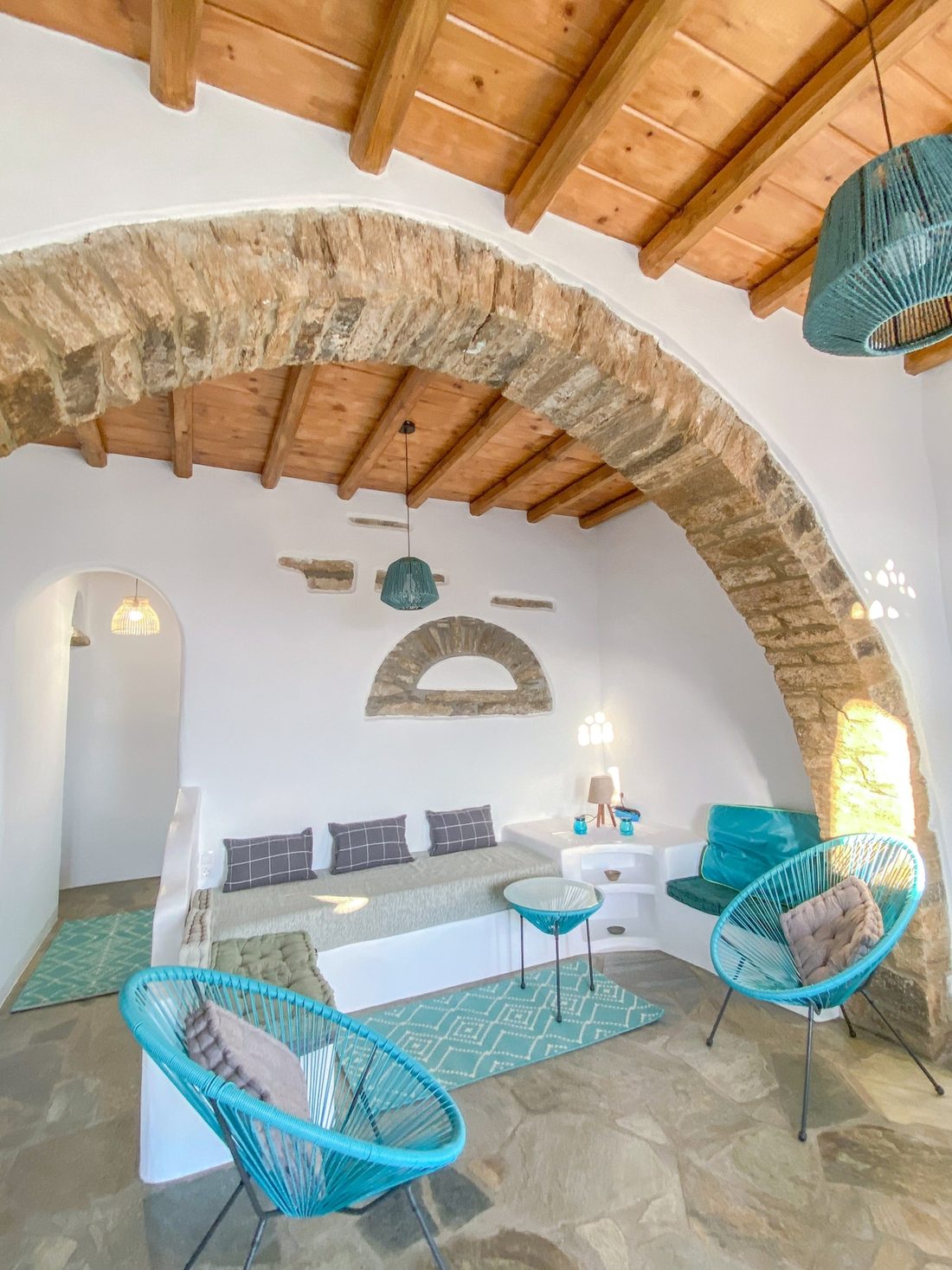
The same hands and the same logic built the villages. Cycladic architecture on Tinos is stone from the island itself: thick walls, small openings, whitewashed lanes, marble lintels over doors and windows, and the carved stone of the dovecotes. A dry-stone terrace and a stone house are close relatives, and when you stay in a restored village house you are living inside the same tradition. If you enjoy architecture, our guide to the villages of Tinos is a good companion to this one.
Join the workshop in Arnados on 14 and 15 November
According to the announcement, the workshop runs from 9:00 to 15:00 on both days, is free, and asks participants to register in advance with the organisers. Bring closed shoes, a hat if the sun is out, and water; a small snack is provided. In November the weather on Tinos can change quickly, so dress in layers. You do not need experience: the point of these days is to learn by lifting, sorting and placing stones next to people who know how.
It is not the first time the island has made room for the craft. In autumn 2025 the Mediterranean Centre for the Environment and the cooperative «To Batiki» ran an open ten-day dry-stone workshop on Tinos with European partners, as part of an Erasmus+ project (Tinos Today, October 2025). Interest in the craft is clearly growing, and it makes a quiet, hands-on reason to visit outside the summer season; see also our notes on Tinos off-season.
How to walk among the walls respectfully
The walls are fragile in one way only: they are held by balance. Please do not climb on them, sit on the tops or pull stones out to make a seat; a stone removed today can bring down a section after the next rain. Keep to the paths, close any field gate behind you, and give goats and farm animals room. Sturdy shoes matter, because the stones on old paths are uneven and can be slippery. For routes that start near our villages, see our guide to hiking on Tinos.
Where to stay
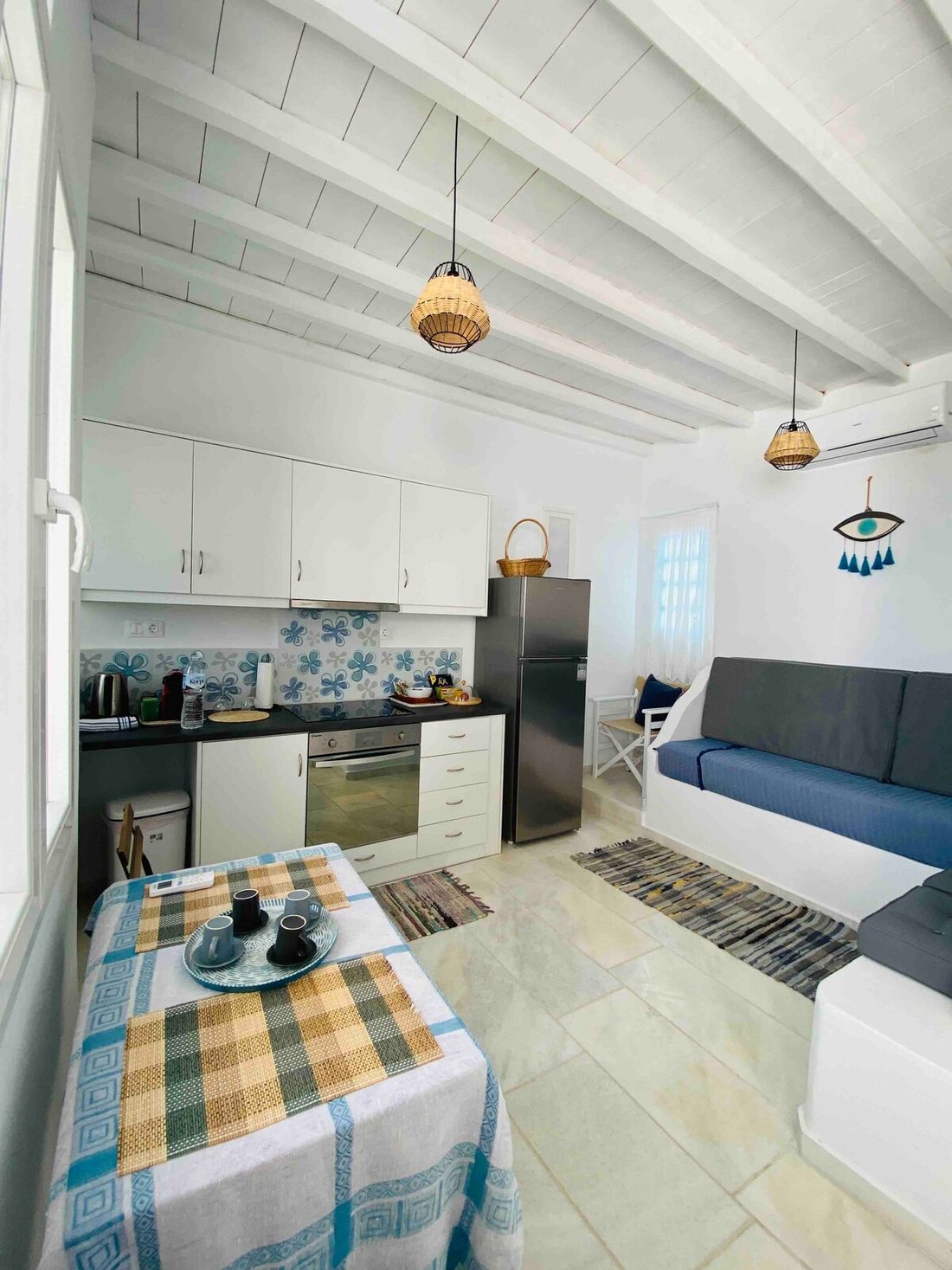
Our four stone houses stand in Dyo Choria and Triantaros, among exactly this kind of terraced landscape, renovated with marble lintels and Cycladic details. Aegean Selfie House has one bedroom for two guests, Emerald View House One and Blabla Door House have two bedrooms each, and Blue Horizon has three bedrooms on two levels. If you are comparing where to stay in Tinos for the workshop weekend or any other time, message us through the enquiry form with your dates and we will suggest the right house.