Look at the middle of Tinos from almost any ridge and one shape will not blend into the landscape: a bare granite crag standing apart from the soft, terraced hills, as though someone had set it down there. This is Exomvourgo, Xombourgo to the islanders, and for roughly five centuries it was the capital of Venetian Tinos. Today it is a ruin, a quiet place of pilgrimage and, for anyone who likes history with their view, the best half-day walk on the island. Our hiking guide mentions it in a paragraph; here is the longer story.
A rock the Venetians turned into a capital
After the Fourth Crusade the Venetian Ghisi brothers took Tinos and Mykonos in 1207, and they chose Exomvourgo, a rock that defends itself, as their stronghold. By the late 14th century the Republic of Venice ruled the island directly, and a walled town grew on the summit and its flanks: houses climbing the stone, churches, cisterns, storerooms. Accounts put its peak at several hundred houses and one to two thousand people, living on a mountain at about 640 metres with the sea laid out below them. Tinos still has one of the largest Catholic communities in Greece, and the villages around the foot of the rock, such as Falatados and Tripotamos, keep the memory of that Venetian world.
Why it held for so long, and how it fell
The fortress turned back Ottoman attacks again and again, among them in 1570 and several times between the 1650s and 1684. It fell in 1715, during the last Ottoman-Venetian war, when a very large Ottoman fleet and army arrived and the garrison negotiated a surrender. Within days the Ottomans had pulled down most of the fortress and town. The Venetians left, Tinos became Ottoman, and the island's life drifted down to the villages and to the sea. What you climb among today is what remained: footings of walls, the outlines of rooms, rubble and rock.
The climb
The walk starts from the church of the Sacred Heart of Jesus (Iera Kardia Iisou), a Catholic church and pilgrimage place on the slope, and is usually described as about twenty minutes up. It is short but steep: a rough path of stones and stepped rock, with a little scrambling near the top and no railings. Allow about an hour for the round trip with time to sit and look. Wear shoes with a proper grip, carry water, and choose the morning or the last hours of daylight, because there is no shade. On windy days the meltemi blows hard on the summit, and in thunderstorms or low cloud the rock is not the place to be.
What you find at the top
A cross stands on the summit, and around it the low ruins of the Venetian town, some of them sheltered corners where shepherds and walkers still rest out of the wind. The view is the reward: terraced hillsides stitched together by dry-stone walls, white villages in the valleys, dovecotes dotting the fields (read about the dovecotes of Tinos), and, on a clear day, Mykonos, Delos and Syros floating on the sea. It is a good place to understand why the Venetians wanted this island, and why the Cycladic architecture of the villages below, stone houses with marble lintels and thick whitewashed walls, looks the way it does.
Making a day of it
Pair the climb with the rest of the island's inner side. The convent of Kechrovouni is another short drive away, and a long lunch in a village kafeneio is the right ending to a morning on the rock. Spring and autumn are the kindest seasons for walking; in high summer start early and finish before the heat.
Where to stay near Exomvourgo
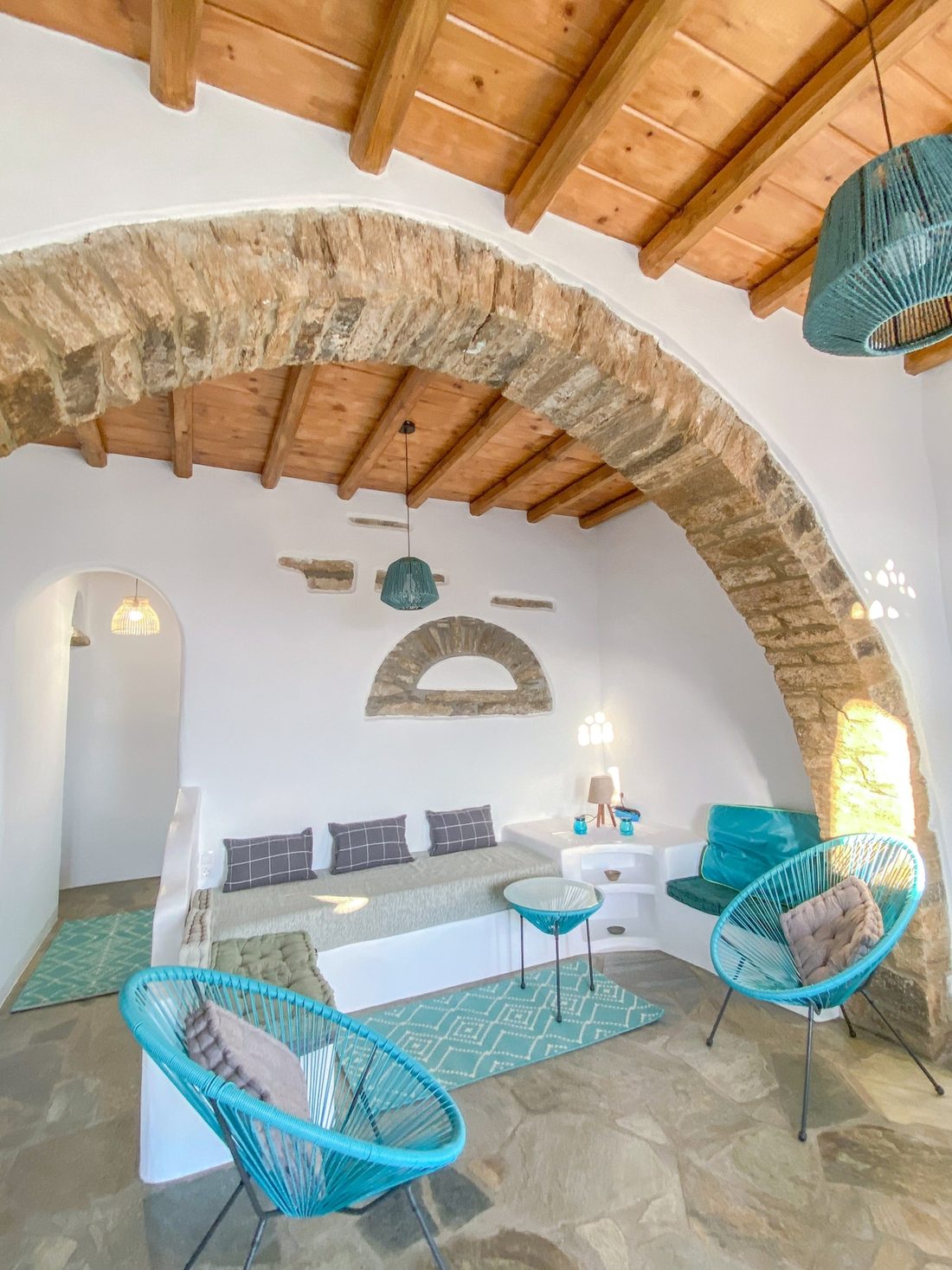
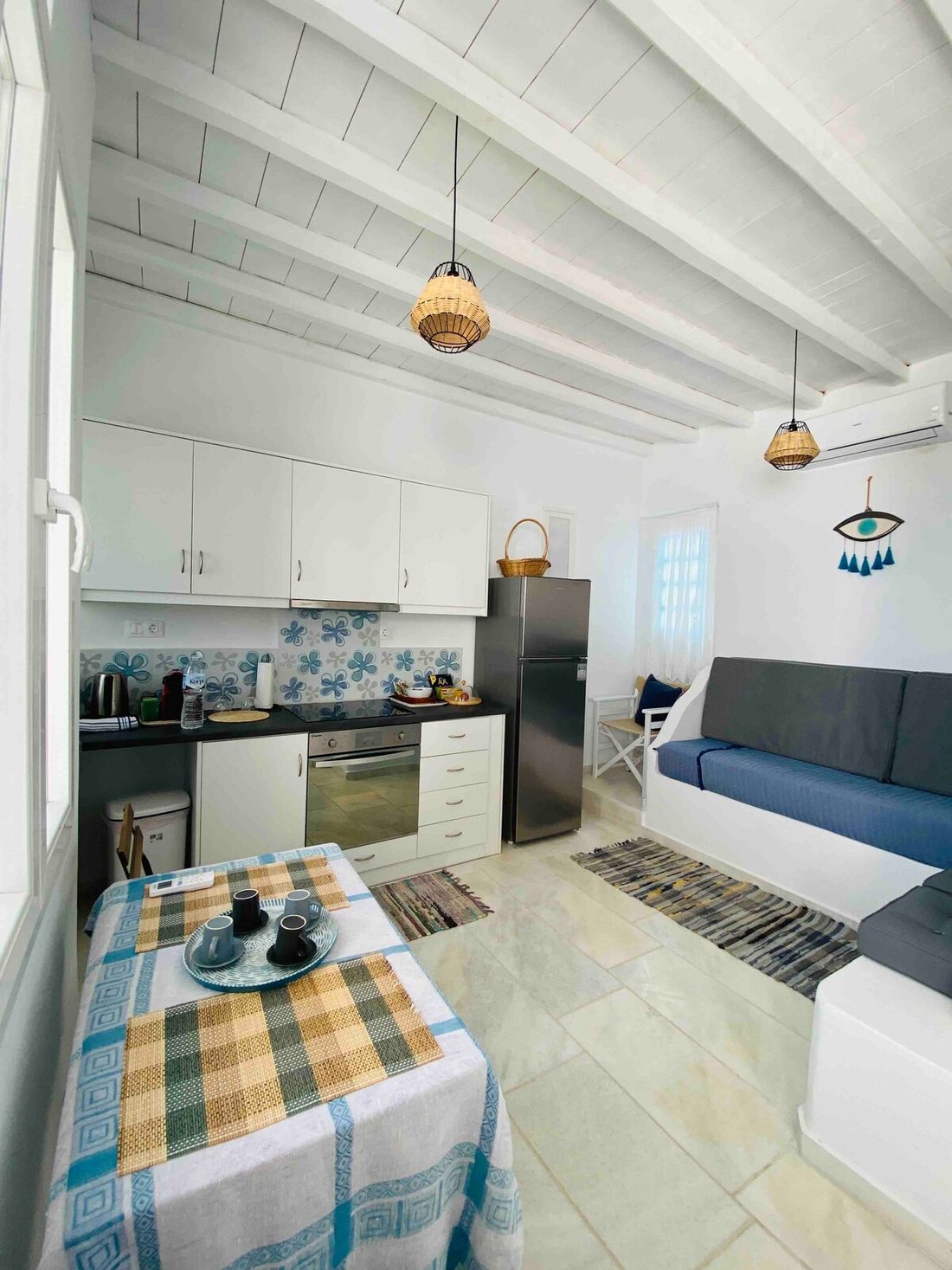
We spend our days in the balcony villages of Dyo Choria and Triantaros, where our four holiday houses are traditional stone houses with marble lintels, renovated into quiet vacation rentals with terraces over the Aegean. Blue Horizon suits walkers travelling as a group, and the others sleep two to six. If you are deciding where to stay in Tinos, message us through the enquiry form with your dates and we will help plan the walk.