A few minutes' drive above our villages, a long white settlement lies along the flank of Mount Kechrovouni — too big for a hamlet, too quiet for a town. This is the Kechrovouni Monastery, the convent of the Dormition of the Virgin, where the story of modern Tinos began in the dreams of an elderly nun in the summer of 1822.
A village of nuns on the mountain
Nobody knows exactly when Kechrovouni was built. Tradition places it in Byzantine times, between the tenth and twelfth centuries, and tells of three devout sisters who saw a strange light over the mountain night after night. They came to live beside the three small chapels that stood here, each building a cell next to one, and a community grew around them — at its height some 120 nuns — under a gentle name the convent still carries: the Lady of the Angels.
What they built is less a monastery than a village. Stone-paved lanes wind between whitewashed cells that are really small houses, each with its own door and steps; arches open onto courtyards and bell towers rise over the roofs. It is Cycladic architecture at its least self-conscious — stone houses, marble lintels, stairways worn smooth — and from around 650 metres the view falls over terraces and dovecotes to Chora and the sea.
Saint Pelagia and the dream of 1822
The convent's most famous daughter was born Loukia in 1752, in the village of Kampos. At fifteen she joined her aunt, a nun named Pelagia, at Kechrovouni, and took her name with her vows. She spent her long life here, remembered less for visions than for work: nursing the sick sisters and begging from village to village around the mountain to feed the poorer ones.
In July 1822, with the War of Independence barely a year old, Pelagia, then about seventy, saw in her sleep a radiant woman who told her that an icon lay buried in a field below the town. Twice she kept silent. The third time, on 23 July, she told her abbess and Bishop Gavriil. On 30 January 1823 a workman's pick split a wooden panel in the earth: an icon of the Annunciation. The church of Panagia Evangelistria rose over the spot, and Tinos became the great pilgrimage island of Greece. Pelagia died in 1834 and was later declared a saint.
What to see inside the walls
Start at the katholikon, the church of the Dormition at the heart of the complex, with its carved and gilded wooden iconostasis. To its right a stone stair climbs to Pelagia's cell, now a shrine, and beside it stands the newer church dedicated to her, where her relic is venerated. A lane leads on to the Taxiarches, the old cemetery church, where she was buried. With the chapels of the Holy Trinity, St John the Baptist, Agia Christina and the Life-Giving Spring, that makes seven churches within the walls. A small museum keeps 18th- and 19th-century icons, church silver and vestments, and the nuns sell their own handiwork, which is how the community lives.
Visiting well: hours, dress and a little quiet
Kechrovouni is a working convent, not a museum, with no ticket office or posted timetable. The sisters' day starts with the bell at five in the morning, and vespers is sung at four. The convent's office keeps roughly ten to one and four to six — the safest windows for a visit; midday is for rest. Times shift around services and feasts; staying with us, ask the evening before and we will check. Dress as for any Greek convent — shoulders and knees covered, a light wrap in your bag — keep your voice low, and ask before photographing the sisters. By car it is about fifteen minutes from Chora and a few minutes from our villages.
The old path up from Dyo Choria
Better still, walk. From the plane-tree square in Dyo Choria the old path climbs out of the village by stone steps, past a spring, a long stone cistern and a dovecote, then threads through Arnados — covered lanes, a marble fountain — to the monastery gate: a little over two kilometres, about an hour at an easy pace. From Triantaros, add the short stretch along the ridge. Beyond the gate the path continues down past chapels, dovecotes and an old mill to Chora, some four kilometres more; take a taxi back up. Go early or late in the day, with water and proper shoes — marble steps polished by centuries of feet are slippery. Our guide to hiking on Tinos covers the wider network.
23 July: the icon comes up the mountain
On 23 July, the feast of Saint Pelagia and the anniversary of her vision, the icon of Panagia Evangelistria is brought up from Chora in the morning and spends the day at Kechrovouni, while the nuns offer coffee, raki and sweets to everyone who has made the climb. After evening vespers it is carried back down to town on foot, a long procession of islanders and visitors behind it and chapel bells ringing as it passes — two hours of walking in the last light, reaching the harbour at nightfall to the island band and fireworks. For the summer's other feasts, see our guide to the panigiria of Tinos.
Where to stay near Kechrovouni
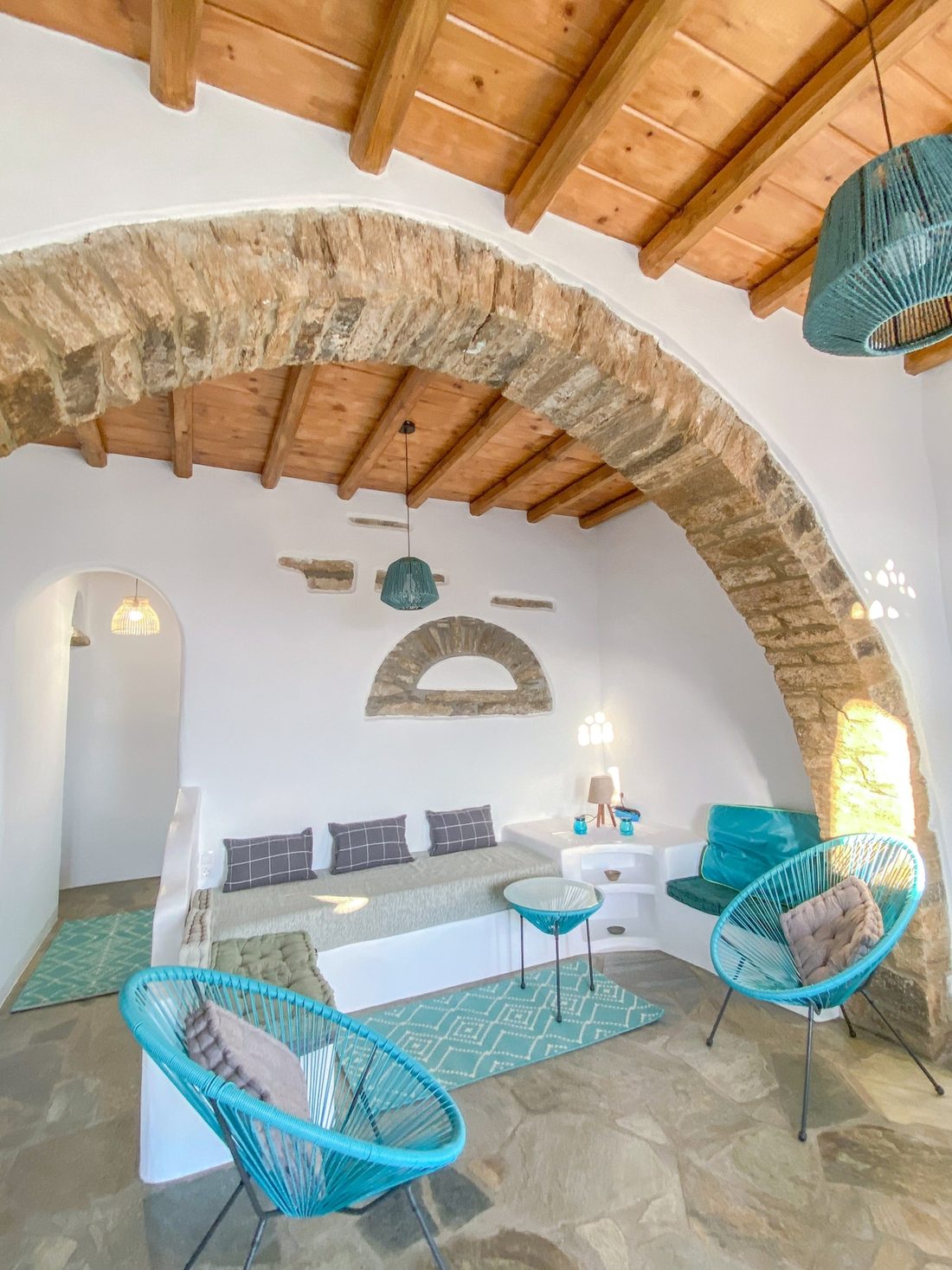
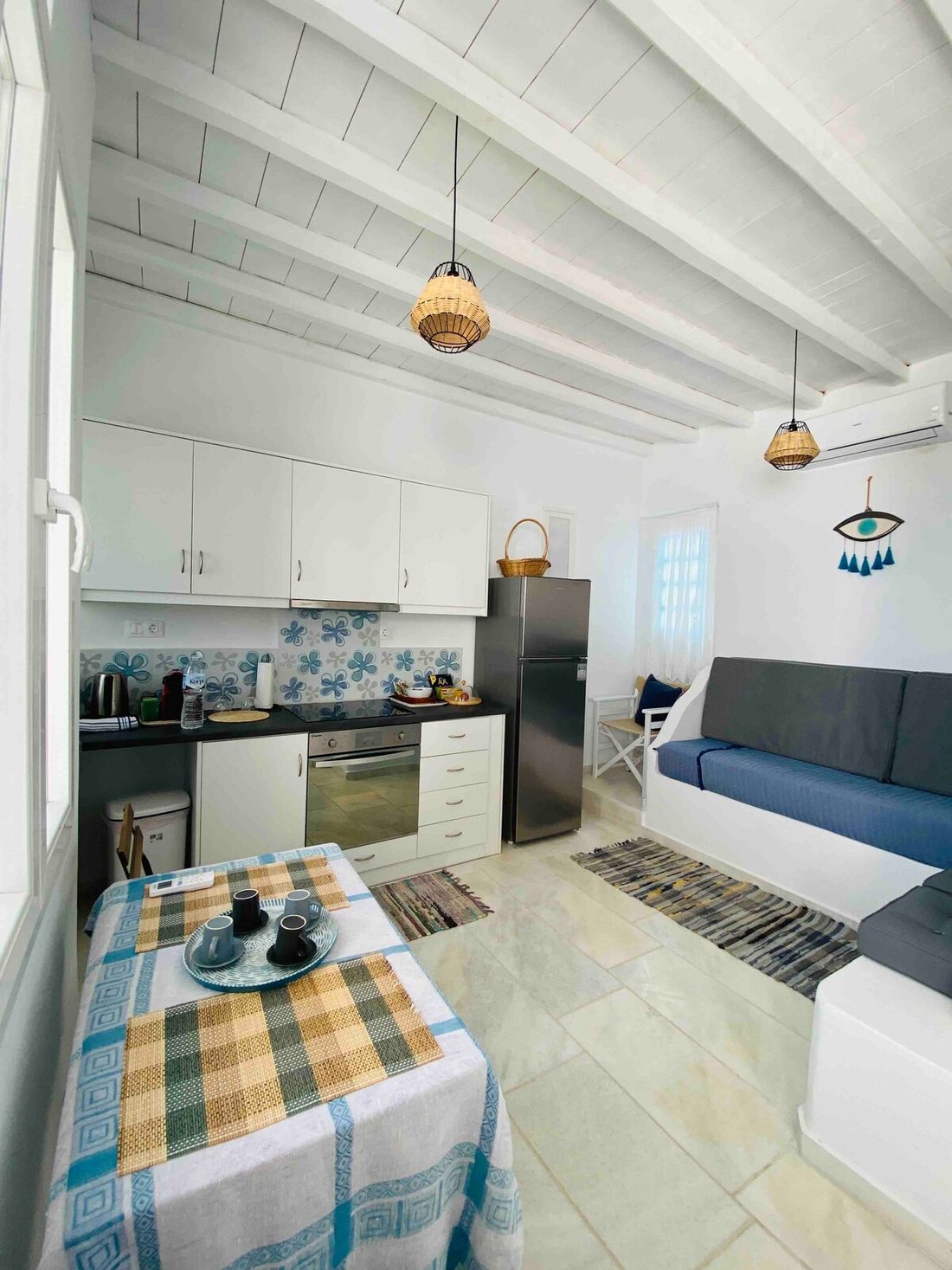
We live on the same mountain. Our four holiday houses sit in Dyo Choria and Triantaros, the balcony villages below the monastery — traditional stone houses with marble lintels and thick walls, renovated into quiet vacation rentals with terraces over the Aegean. Emerald View House One is two minutes from the square where the path to Kechrovouni begins; Blue Horizon, Blabla Door House and Aegean Selfie House are a short walk along the ridge in Triantaros. If you are deciding where to stay in Tinos, message us through the enquiry form with your dates.