Every island in the Cyclades has a Panagia. Tinos has the Panagia. Panagia Evangelistria — Our Lady of the Annunciation, known to Greeks simply as the Megalochari, "She of Great Grace" — is the most visited church in the country and the reason the ferries fill with pilgrims every August. Guests at our holiday houses in Dyo Choria and Triantaros often ask what the story is. It begins not in Chora but on the mountain directly above our villages, and it deserves a slow telling.
A nun's dream and an icon in the earth (1822–1823)
In July 1822, with the War of Independence barely a year old, an elderly nun called Pelagia at the Kechrovouni monastery — the old convent on the ridge above Arnados, Dyo Choria and Triantaros — dreamed on three consecutive Sundays of a luminous woman asking her to dig in a field below the town, where a church of St John the Baptist had burned in the tenth century and been forgotten. Pelagia, in her seventies and famously distrustful of her own visions, finally confided in her abbess and the bishop. On 30 January 1823 a workman's pick split a wooden panel in two without touching the figures painted on it: the Virgin kneeling in prayer and the Archangel Gabriel holding a lily — an Annunciation, which tradition attributes to St Luke himself. A nation was being born in blood, and here was a Byzantine icon rising out of the soil of a free island. Kolokotronis, Miaoulis and Makriyannis came to kneel before it, and donations for a church poured in from every corner of the Greek world.
Marble for a new nation: the church of 1830
Designed by a Tinian architect, Efstratios Kalonaris, and inaugurated in 1830, the church was the first great architectural work of the modern Greek state — raised while the state itself was still being negotiated. It is a three-aisled basilica under a dome, with a two-storey arcaded façade, a bell tower and a pair of sweeping marble staircases. The stone came from the quarries around Panormos and Pyrgos in the north of the island, with Parian and Delian marble alongside, cut by the same families of craftsmen whose fanlights and marble lintels sit over the doorways of every village; if you have read our piece on Pyrgos, the marble village, you will recognise the hand. The arcades, chapels and cells that ring the courtyard were finished around 1880.
The road the pilgrims climb — and the museums in the courtyard
From the ferry ramp, Leoforos Megalocharis runs uphill in a straight line to the church, roughly 800 metres. Along its edge lies a strip of carpet, and on any day of the year you may see someone moving up it on hands and knees, keeping a vow. Step around them, never over. At the top waits a courtyard of black-and-white pebble mosaic, a marble fountain of 1845, hibiscus and white poplars, then the stairs up into candle smoke and the glitter of the icon, now almost hidden beneath two centuries of gold, silver and jewelled offerings. Beneath the church, the chapel of the Life-Giving Spring marks the exact spot of the discovery; its well gives the holy water pilgrims carry home. The complex is also one of the finest free galleries in the Aegean: the Museum of Tinian Artists, with works by the island's own Halepas, Filippotis, Gyzis and Lytras; a gallery of more than a hundred paintings; a museum of icons and ecclesiastical treasures; the Sacristy; and the Elli mausoleum. Give it an hour, ideally before the tour groups come up from the port.
Four feasts a year
The Evangelistria celebrates four times. On 30 January the finding of the icon is re-enacted, the icon carried down to the spring the evening before. On 25 March the Annunciation coincides with Greek Independence Day and the church keeps an all-night vigil. On 23 July the island remembers Pelagia's vision with a quieter feast up at Kechrovouni. And on 15 August, the Dormition, comes the great day: the icon is carried through the streets above the heads of kneeling pilgrims, the President or Prime Minister usually attends, and the navy lays a wreath for the cruiser Elli, torpedoed in the harbour by an Italian submarine on this same morning in 1940; the Mausoleum of the Elli, inside the complex, keeps a fragment of the torpedo. For everything else that happens on the island that week, see our guide to the panigiria of Tinos.
Kechrovouni: the monastery above our villages
To close the circle, drive — or walk — up to where it began. The Kechrovouni monastery sits at around 650 metres on the ridge above Arnados, a few minutes from Dyo Choria and Triantaros. By tradition it was founded in the tenth or eleventh century by three sisters who shared the same dream, which makes it one of the oldest in the Cyclades. It is a village in itself: whitewashed lanes, arched passages, small stone houses that serve as cells, seven churches inside the walls. The nuns will show you Agia Pelagia's cell, where her relics are kept, and the view falls away across terraces and dovecotes to Chora, with Mykonos and Delos floating behind. Go in the early evening, when the light turns the marble gold, in modest dress and with quiet voices. The old stone footpath linking the monastery, Arnados and Dyo Choria is one of our favourite short walks.
Visiting well
The church is open every day from early morning until evening; the museums keep shorter hours. Shoulders and knees covered — carry a light wrap — hats off, no flash, no photographs during services. Light a candle at the entrance, join the line for the icon, and step aside for anyone on their knees. Outside the feast days, a weekday morning in May, June, September or October is blissfully calm; on 15 August, come to watch rather than to visit, and be in town by eight.
Where to stay for the Evangelistria
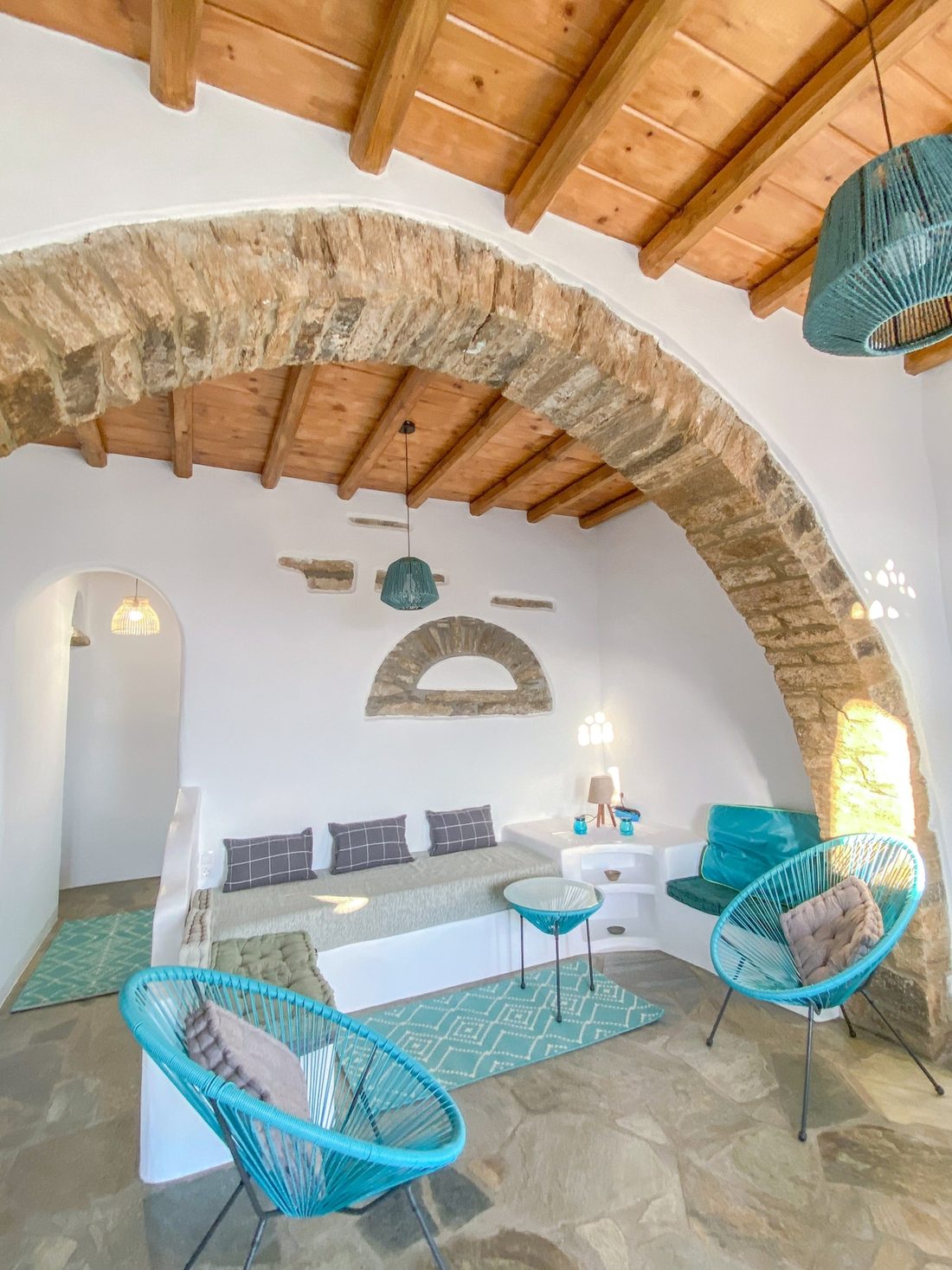
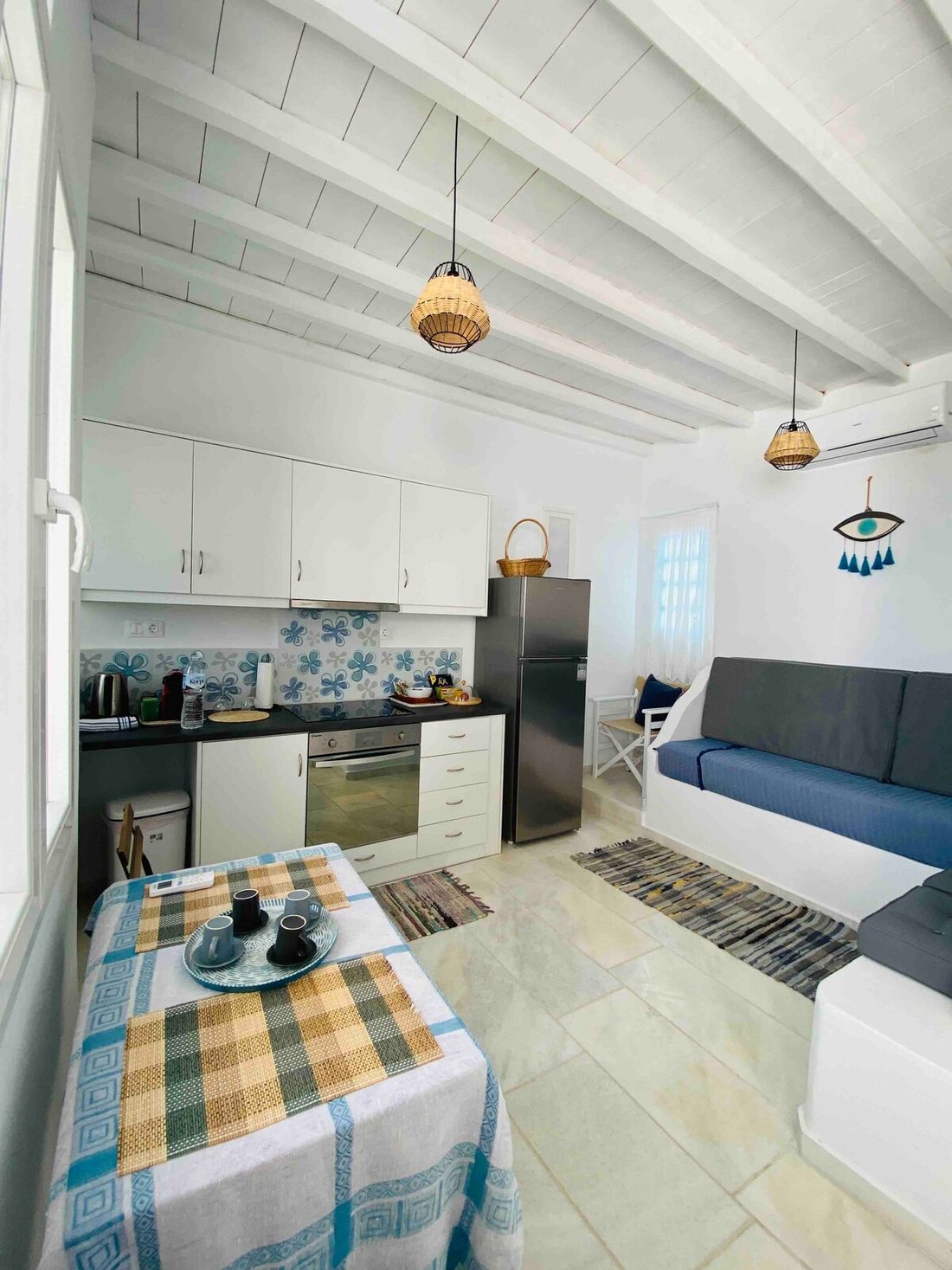
Chora is the pilgrimage; the villages are the island. Our four holiday houses sit in Dyo Choria and Triantaros, on the same mountain as Kechrovouni and fifteen minutes by car from the harbour — traditional Cycladic architecture, stone houses with marble thresholds and terraces over the Aegean, renovated into quiet, comfortable vacation rentals. From here you can be at the church for the early liturgy and back on your terrace for breakfast, or walk up to the monastery before the heat. If you are working out where to stay in Tinos, see the houses below and message us through the contact section for dates and our best direct rate.